
How to Master TOEFL Writing in 2026: A Guide to High-Scoring Arguments
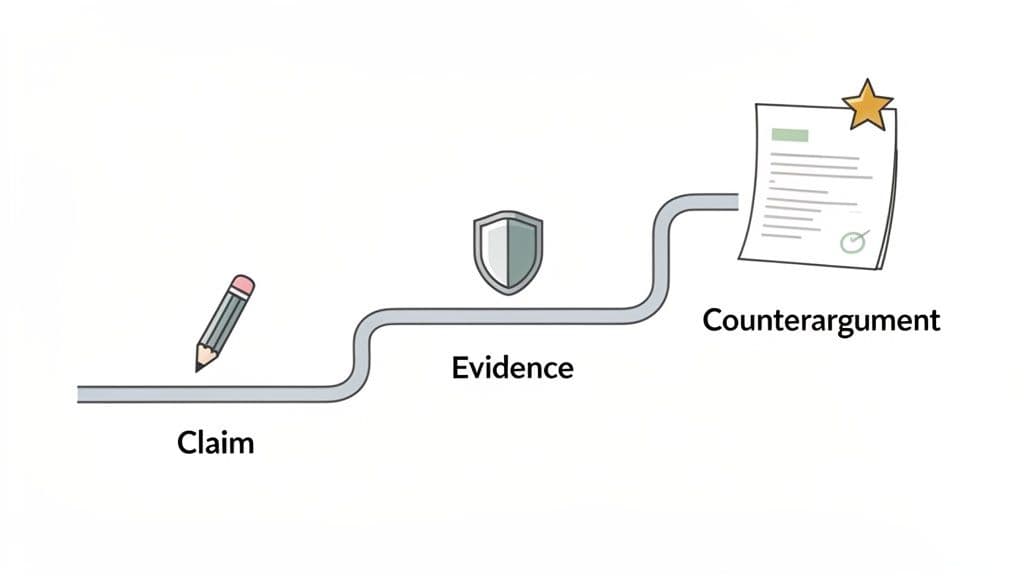
If you want a high score on the TOEFL Writing section, forget about cramming complex vocabulary. The real secret to success, especially for the 2026 format, is a clear, logical structure that the graders can follow without a second thought.
You're probably feeling the pressure, and that's completely normal. The TOEFL is a high-stakes test. But we're going to turn that anxiety into confidence by giving you a clear, actionable plan for each writing task. For the Academic Discussion task, the formula is simple but powerful: make your claim, back it up with solid reasoning, and engage with the other students' ideas.
Let's get you ready to earn the score you deserve.
Your Blueprint for High-Scoring TOEFL Writing Tasks
Staring at a blank screen with the clock ticking down is stressful. Let's replace that anxiety with a concrete plan. A good structure is your roadmap to a higher score, proving to the grader that you can build a persuasive argument under pressure. This applies to all three writing tasks you'll face in the 2026 TOEFL format: Build a Sentence, Write an Email, and the Academic Discussion.
Think of it this way: your ideas are just a jumble until you give them a framework. Without a clear structure, even brilliant points get lost. For the 10-minute Academic Discussion task, you don’t have time to reinvent the wheel. You need a reliable blueprint.
The Power of a Classic Structure for the Academic Discussion
The classic argumentative structure is your best friend for the Academic Discussion task. You won't be writing a full five-paragraph essay, but the logic behind it is what counts.
Why does it work so well for TOEFL? The ETS rubrics for the 2026 format award up to 30% of your writing score for "Development, Organization, and Cohesion." This structure is a direct answer to that requirement. You can learn more about exactly what the graders look for in our deep dive on the TOEFL writing rubric.
In fact, ETS's own data shows that the majority of top-scoring TOEFL essays—those in the 26-30 score range—follow a tight thesis-evidence-rebuttal flow.
Key Takeaway for Anxious Test-Takers: A predictable structure isn't boring; it's smart. It gives you a clear path to follow when the pressure is on, signaling to the grader that you can organize your thoughts logically—a core academic skill they are specifically looking for.

Core Components of a TOEFL Argument
Once you master these building blocks, putting together a strong argument becomes second nature. This skill doesn't just help with the discussion task; it trains your brain to see how ideas connect, which is a huge advantage for all parts of the TOEFL.
Let's break down exactly what you need for a high-scoring response on the Academic Discussion task. Think of it as a checklist for success.
Core Components of a TOEFL Academic Discussion Post
| Post Part | Purpose | Actionable Tip for a High Score (25+) |
|---|---|---|
| Clear Position (Thesis) | State your main argument directly. | In your first or second sentence, clearly state your opinion in response to the professor's question. |
| Supporting Reasons & Evidence | Explain why you hold your position. | Provide one specific example from your personal experience or a logical reason. This is crucial. |
| Acknowledgment of Others | Show you're engaged in the discussion. | Start by directly mentioning another student's point (e.g., "I agree with Sarah...") and then add your own idea. |
| Concluding Thought | Wrap up your argument. | End with a simple final sentence that summarizes your contribution, reinforcing your main point. |
By consistently including these four elements, you create a response that is easy for the grader to read, understand, and—most importantly—give a high score. It’s a simple formula that gets results. You can practice this structure right now with the free tools at Writing30.com.
Nailing Your Opening and Main Point
Your first couple of sentences are everything in the Academic Discussion task. You've got to set the stage for your argument right away. There’s simply no time for a slow, meandering intro.
Forget starting with vague phrases like "People have different opinions about..." It’s a waste of precious words and time. Jump straight into the topic with a compelling opening that shows the grader you understand the question and have a strong point of view.

The Role of Your Main Point (Your "Thesis")
Your main point, or thesis, is the engine of your entire post. This one sentence is the single most important part of your contribution. It's not just a topic announcement; it's your core argument, telling the reader precisely what you believe and why.
For the Academic Discussion, your thesis has to be debatable. That means it takes a clear stance that someone could logically argue against.
A powerful thesis is the foundation of a high-scoring response. It's a clear promise to your reader, outlining exactly what you intend to prove.
Mastering this skill—getting straight to the point—is also incredibly useful for the "Write an Email" task, where clarity and purpose are key to a good score.
From Weak to Strong: A Thesis Comparison
Let's break down what this looks like with a real-world example from a TOEFL-style prompt: "Your professor is asking for opinions on whether learning is more effective when done in groups or individually."
Here's a common, but weak, attempt:
- Weak Thesis: "Group study and individual study both have advantages."
This statement is a dud. It’s a fact, not an argument. It's not debatable, and it gives the grader zero clue what your position is. You need to take a side.
Now, let's make it a little better:
- Better Thesis: "I believe individual study is more effective than group study."
This is an improvement because it takes a clear side. We know where you stand. But it’s still missing the crucial why.
Finally, here’s a thesis that sets you up for a top-scoring post:
- Strong Thesis: "I think studying individually is far more effective because it allows students to focus on their specific weaknesses without the distractions that often come with group work."
This thesis is a powerhouse. Here's why:
- It’s Debatable: It takes a firm, clear position.
- It’s Specific: It provides two concrete reasons ("focus on weaknesses" and "without distractions").
- It’s a Roadmap: It tells the grader exactly what your supporting example will be about.
When you start with a thesis this strong, the rest of the post practically writes itself. While it takes some practice, you can get a head start by studying effective TOEFL writing templates to see how a strong thesis integrates into a full response.
Building Your Argument with Strong Support
If your opening sets the stage, your supporting sentences are where you win the argument. This is your chance to move from telling the grader your position to showing them why you're right.
Think of your supporting sentences as a mini-argument. They should tackle one single point that proves your thesis. For a timed task like the TOEFL Academic Discussion, you have just 10 minutes to build a case that’s logical, convincing, and easy to follow. Don't worry, you can do this!

The Anatomy of a Perfect Supporting Paragraph
A simple but incredibly powerful framework is the T.E.A. model: Topic Sentence, Evidence, and Analysis. This structure is a grader's best friend because it makes your ideas well-developed and easy to score.
- Topic Sentence: This is your post's first sentence, your main point or thesis.
- Evidence (or Example): Here's where you back up your claim. For the TOEFL, this must be a specific personal story, a logical reason, or a real-world example. This is non-negotiable for a high score.
- Analysis: This is where the points are scored. You must explain how your evidence proves your topic sentence. Don't ever assume the grader will connect the dots for you.
Let’s use the strong thesis we developed earlier: "I think studying individually is far more effective because it allows students to focus on their specific weaknesses without the distractions that often come with group work."
Putting It Into Practice: A Sample Post
Here’s an Academic Discussion post built with this structure.
(Topic Sentence/Thesis) I respectfully disagree with the idea that group study is always better. I think studying individually is far more effective because it allows students to focus on their specific weaknesses without the distractions that often come with group work. (Evidence) For example, when I was preparing for a difficult math exam last semester, I first tried studying with friends. We ended up chatting more than studying. But when I switched to studying alone, I was able to spend two solid hours focused only on the calculus problems I found most difficult. (Analysis) This experience showed me that individual study is crucial for targeted learning, as it ensures my study time is spent exactly where I need it most. It helped me improve my score significantly, which probably wouldn't have happened in a group.
See how that works? The post is focused, uses a specific personal example, and clearly links that example back to the main idea. The language is direct and confident, which is exactly what graders want to see.
The Power of Specific Evidence
Vague claims are the fastest way to a low score. To impress a grader, you need concrete, specific support. This is what separates a score of 24 from a 27+.
A key insight for the TOEFL: Your personal examples are 100% valid evidence. The graders aren't fact-checking your life story; they are checking your ability to use that story to support an argument logically.
Building strong paragraphs depends on your ability to build strong sentences. Clear, correct sentence structure is the foundation of any persuasive point. You can get more practice with this in our guide on how to master the TOEFL Build a Sentence task, as those same skills are crucial here.
The only way to get good at this is through practice. On Writing30.com, our AI gives you instant feedback on unlimited practice posts, showing you exactly where your arguments are weak and how to strengthen your evidence and analysis for a higher score.
Using Counterarguments to Boost Your Score
If you want to move beyond a basic response and hit a top-tier score (25+), you have to show the grader you've thought about the issue from all sides. A truly great argument doesn't just push its own agenda; it acknowledges the other side before explaining why its own position is stronger.
This move is called a counterargument and rebuttal. Think of it as a respectful debate. You show you're listening to the opposing view, which makes your own argument seem more credible and balanced.

Why This Is a Game-Changer for Your Score
This skill is absolutely critical for the TOEFL Academic Discussion task, part of the 2026 format. In this task, you’re not writing in a vacuum—you must read and respond to posts from other "students."
Directly addressing another student's point shows the grader you are actively engaged in the discussion. This is what separates a good score (22-24) from a great score (25+). It directly fulfills a key part of the rubric: "makes a well-supported contribution to the discussion."
Expert Insight: Acknowledging another viewpoint doesn't weaken your post—it strengthens it. By anticipating or addressing an opposing argument, you prove your own position is the more robust and carefully considered one. This shows confidence!
A Quick and Simple Rebuttal Formula
The trick is to handle the counterargument efficiently so it doesn't hijack your entire response. Here’s a simple but powerful three-step approach perfect for the Academic Discussion task.
- Acknowledge: Start by clearly and respectfully stating the opposing viewpoint, often mentioning the other student by name.
- Refute: Immediately pivot and explain why that view is incomplete or less persuasive, then introduce your main point.
- Reinforce: Bring the focus back to your original thesis, showing why your argument holds up better. This is done with your example and analysis.
This structure keeps your response organized and ensures you remain in control of the argument.
Sentence Starters and Examples in Action
Knowing how to introduce a counterargument gracefully is half the battle. You don't want to sound aggressive. Practice with these phrases to make your rebuttals sound smooth and academic.
Sample Prompt: The professor asks if technology in the classroom is always beneficial. Another student, Leo, argues that tablets and laptops are distracting. You disagree.
Sentence Starters for Acknowledging:
- "While I understand Leo's concern about..."
- "I can see Leo’s point about..."
- "It's a valid point that..."
- "I agree with Leo that distractions are a concern, but..."
Example Response:
(Acknowledge) I can see Leo’s point about technology like tablets being a potential distraction in the classroom. (Refute) However, I believe this view overlooks how modern educational tools, when used correctly, can create interactive lessons that actually increase student engagement. (Reinforce with example) For instance, in my history class, we used a virtual reality app to tour ancient Rome. This was far more memorable and engaging than just reading a textbook. Ultimately, technology's ability to make learning more personalized outweighs the risk of distraction.
This quick rebuttal adds incredible depth. It proves you can think critically and build a multi-layered argument—exactly what top-scoring responses do. For a deeper dive, check out our guide on how to integrate counterclaims and rebuttals into your writing.
The best way to get comfortable with this is practice. Head over to Writing30.com and try our free practice tool. You’ll respond to real Academic Discussion prompts and get instant feedback on your structure, helping you master the art of the rebuttal before test day.
Writing a Strong, Confident Conclusion
You've built a solid argument and backed it up with good evidence. Don't throw it all away now. A weak or nonexistent conclusion is one of the most common ways test-takers lose points they’ve worked hard to earn.
So many students just stop writing when the clock runs out. That’s a mistake. A good conclusion is your last chance to drive your point home and remind the grader how strong your post is. It’s about locking in a high score.
More Than Just a Summary
Let's clear something up: a conclusion isn't just a copy-paste of your thesis. While you do need to bring your main point back, you have to say it in a new way.
More importantly, your conclusion must elegantly wrap things up. The number one rule? Never add new arguments or evidence in your conclusion. Its job is to seal the deal, not start a new conversation. For the TOEFL Academic Discussion, a solid one or two-sentence conclusion is all you need.
Here's a simple, effective way to structure it:
- Restate Your Thesis: Rephrase your main point with different vocabulary.
- End with a Final Thought: Give your post a sense of finality by answering the "so what?" question. What's the bigger picture?
Let's use our running example: "I think studying individually is far more effective..."
Here’s how a strong conclusion looks in action:
In the end, while group study has its place, the focused, distraction-free environment of individual study is ultimately more beneficial for mastering difficult subjects. True learning comes from understanding personal weaknesses, not just from group discussion.
See how that works? It restates the thesis and finishes with a powerful final thought that sticks. It’s concise and confident.
Your Final One-Minute Revision Checklist
Those last 60 seconds of your 10-minute writing time are absolutely critical. Using this time to quickly proofread can be the difference between a good score and a great one. A clean response tells the grader you're a careful, skilled writer.
Pro Tip: Don't try to rewrite whole sentences in the final minute. You'll run out of time. Instead, hunt for small, high-impact errors. ETS rubrics for all 2026 writing tasks, from Build a Sentence to the Academic Discussion, reward grammatical accuracy.
Here’s a quick checklist to burn through:
- Typos and Spelling: Quickly scan for obvious misspellings. These are easy points to get back.
- Common Grammar Mistakes: Check for subject-verb agreement (e.g., "The student write" should be "The student writes") and make sure your verb tenses are correct.
- Clarity: Read it in your head. Does anything sound awkward? A quick word change can often fix it.
Even a quick polish can elevate your response. Mastering how to structure an argumentative post means planning for these final, crucial moments.
Ready to put these strategies to the test? The fastest way to build confidence is through real practice. Try a free practice set on Writing30.com today and get instant feedback on your structure and an estimated TOEFL score in seconds.
Practice and Final Preparation Tips
Knowing the theory behind a great argument is one thing. Actually writing one under pressure on test day is another game entirely. Success comes when you can combine all these skills with both speed and accuracy. Remember, you can do this!
It helps to remember that every part of the TOEFL writing section is connected. For instance, the grammar and word order skills you sharpen for the Build a Sentence task are the exact same skills that make your Academic Discussion posts clearer and more persuasive. Likewise, the ability to be direct and clear in the Write an Email task will help you state your thesis confidently.
Turn Practice into Performance
Your goal should be to make the post structure so automatic that you barely think about it during the exam. This frees up crucial mental energy to focus on what you actually want to say. The only way to get there is through timed practice.
That 10-minute clock for the Academic Discussion task can feel intimidating, but with practice, you'll learn to tame it.
My Personal Tip: Don't just practice writing. Practice writing under the exact pressure of the test. Set a timer for 10 minutes and force yourself to write a complete response from start to finish. This is how you build the muscle memory you'll rely on when the score actually counts.
After the timer goes off, shift into review mode. Look at your work with a critical eye, specifically for structure. Ask yourself:
- Did I state my main point clearly in the first sentence or two?
- Does my example directly and obviously support that main point?
- Did I explain how the example proves my idea?
- Did I address another student's point?
This kind of focused review is what helps the framework stick. For more ideas on how to get the most out of your study sessions, check out our other guides with writing practice tips for the TOEFL.
The more you do this, the more the structure will stop feeling like a rigid formula and start feeling like your own, natural voice.
Ready to see how you stack up? Try a free mock test on Writing30.com to get a feel for real exam conditions and receive instant feedback on your writing.
Your Top TOEFL Writing Questions, Answered
Let's tackle some of the most common questions I hear from anxious students about writing for the TOEFL. Getting these details right can make a huge difference, and my goal is to give you clear, practical advice you can use immediately.
How Long Should My Academic Discussion Post Be?
You should be aiming for 120 to 170 words. While the official requirement is just a 100-word minimum, my analysis of high-scoring responses (25-30) shows they almost always land in that slightly longer range.
This gives you just enough room to state your argument, back it up with a solid example, connect to another student's idea, and wrap it up. Remember that quality beats quantity. A focused, well-argued 130-word post will always outscore a rambling 180-word one.
Can I Use A Template for My TOEFL Post?
Yes and no. You should absolutely have a mental structure (like Acknowledge-Thesis-Example-Conclusion) that you can rely on. But you must never, ever memorize and plug in pre-written sentences.
The ETS grading software, e-rater®, is specifically built to flag formulaic language, and using it is a fast track to a low score. Think of the structure as the blueprint for a house—it’s a reliable guide. But the materials you build with—your specific ideas, vocabulary, and examples—have to be unique to every single prompt.
Key Takeaway: The goal isn't to copy-paste phrases. It's to practice the structure so much that it becomes your natural way of organizing thoughts under pressure.
What Are the Biggest Mistakes to Avoid?
After grading thousands of student responses, I can tell you that the same few mistakes pop up over and over again. Just being aware of them is half the battle.
Here are the top issues that consistently drag scores down:
- A vague main point that doesn't take a clear, debatable position.
- Relying on generalizations instead of a specific, concrete personal example.
- Just summarizing what the other students said without adding your own unique argument.
- Messy organization that makes your argument hard to follow.
- Monotonous sentence structure, like starting every sentence with "I think..."
The fastest way to catch these problems in your own writing is to get targeted feedback. The AI tools on Writing30.com are trained on these exact issues and give you instant, actionable suggestions to help you improve.
How Should I Manage My Time in the Academic Discussion Task?
With only 10 minutes on the clock, every second is precious. Your time management plan is just as important as your writing ability. Don't panic; just follow the plan.
I drill this breakdown into all my students until it becomes second nature:
- Minutes 1-2: Plan. Quickly read the prompt and the student comments. Decide on your main point and which student you'll respond to. Jot down a super-fast outline (just your thesis + one key example).
- Minutes 3-8: Write. Now, it’s all about execution. Draft your response, focusing your energy on developing your point with good support and analysis. Don't second-guess yourself—just write.
- Minutes 9-10: Proofread. Use the last bit of time to hunt for typos and simple grammar mistakes. This final polish can easily bump your score.
Feeling more prepared? The only way to truly master these skills is through practice. Writing30 offers unlimited, realistic TOEFL prompts for every task in the 2026 format, including Build a Sentence, Write an Email, and Academic Discussion. You'll get instant, rubric-aligned feedback on your structure, grammar, and vocabulary. Give our free practice sets a try and get your estimated TOEFL score today at https://writing30.com.
Ready to Practice?
Try all 3 TOEFL 2026 writing tasks with instant AI feedback.
Tags
Ready to Improve Your TOEFL Writing?
Get instant AI-powered feedback on your TOEFL writing. Practice with real prompts and see your score improve.
Try Writing30 AI