Mastering Counterclaims and Rebuttals for the TOEFL (2026 Format)
Struggling with the TOEFL Writing section? It's a common feeling, but you're in the right place to build confidence. Many test-takers believe a high score comes down to perfect grammar and a big vocabulary, but that’s only half the story. The real key to unlocking a top score, especially with the 2026 exam format, is the strength of your arguments.
This guide will walk you through a powerful technique that ETS raters love to see: mastering counterclaims and rebuttals. Don't worry, we'll break it down with simple steps and practical examples you can start using today.
Your Secret to a Higher TOEFL Writing Score
If you want to move beyond an average score, you have to do more than just state your opinion. The TOEFL isn't just a language test; it's a measure of your readiness for academic life. Scorers want to see that you can think critically and engage with ideas on a deeper level—just like you would in a university seminar. Taking this step shows you're aiming for a score in the high 4s or a perfect 5.
This is where counterclaims and rebuttals come in. Think of it as a respectful, intelligent debate packed into your writing.
- A counterclaim is you showing you understand the other side of the argument. You acknowledge a valid, opposing point of view.
- A rebuttal is your response. It’s where you explain, with evidence or logic, why your original position is still the stronger one.
By doing this, you're not just giving an opinion; you're demonstrating sophisticated critical thinking. You're showing the grader that you can thoughtfully consider multiple perspectives and still defend your own. This isn’t just a "nice-to-have" skill—it's what separates a good score from a great one. It’s a clear signal you’re ready for the demands of academic discourse, which is a major factor in the official TOEFL writing rubric.
This is especially true for the Academic Discussion task. Imagine a classmate makes a point in the discussion forum. A basic response is just to agree or disagree. A high-scoring response, however, does more. You might write, "While I understand David's point about the costs, it's crucial to also consider the long-term benefits because..." That one sentence instantly makes your contribution more complex and valuable.
In this guide, we'll break down exactly how to do this. We'll give you clear examples, go-to sentence starters, and step-by-step strategies you can use in your exam. By the time you're done, you'll have a clear plan for using counterclaims and rebuttals to push your score higher.
Understanding Counterclaims and Rebuttals in TOEFL Writing
Let's start with a simple idea: What separates a good argument from a truly great one? It’s not just about proving you’re right. It’s about showing you understand why someone else might disagree—and then explaining why your point is still stronger. This is the power of counterclaims and rebuttals, and you can absolutely master it.
Think of it like a debate. A counterclaim is where you pause and say, "Okay, I see your point. Some people might argue that..." You're acknowledging the other side of the coin. This shows the evaluator you've thought deeply about the topic, not just your own opinion.
A rebuttal is your immediate, strategic response. It's where you pivot back and say, "...however, that perspective overlooks a critical detail." This is where you prove your argument is more robust. This one-two punch is a hallmark of sophisticated academic writing that scores well.
The Power of Acknowledging the Other Side
This skill is absolutely essential for the TOEFL Academic Discussion task. You aren't just writing an essay into a void; you're stepping into an ongoing conversation with other students. Acknowledging a classmate's point before making your own is a sign of high-level communication that graders are trained to reward.
Acknowledging an opposing view doesn't weaken your argument—it strengthens it. By showing you understand the complexity of a topic, you build credibility and make your own position appear more thoughtful and well-reasoned.
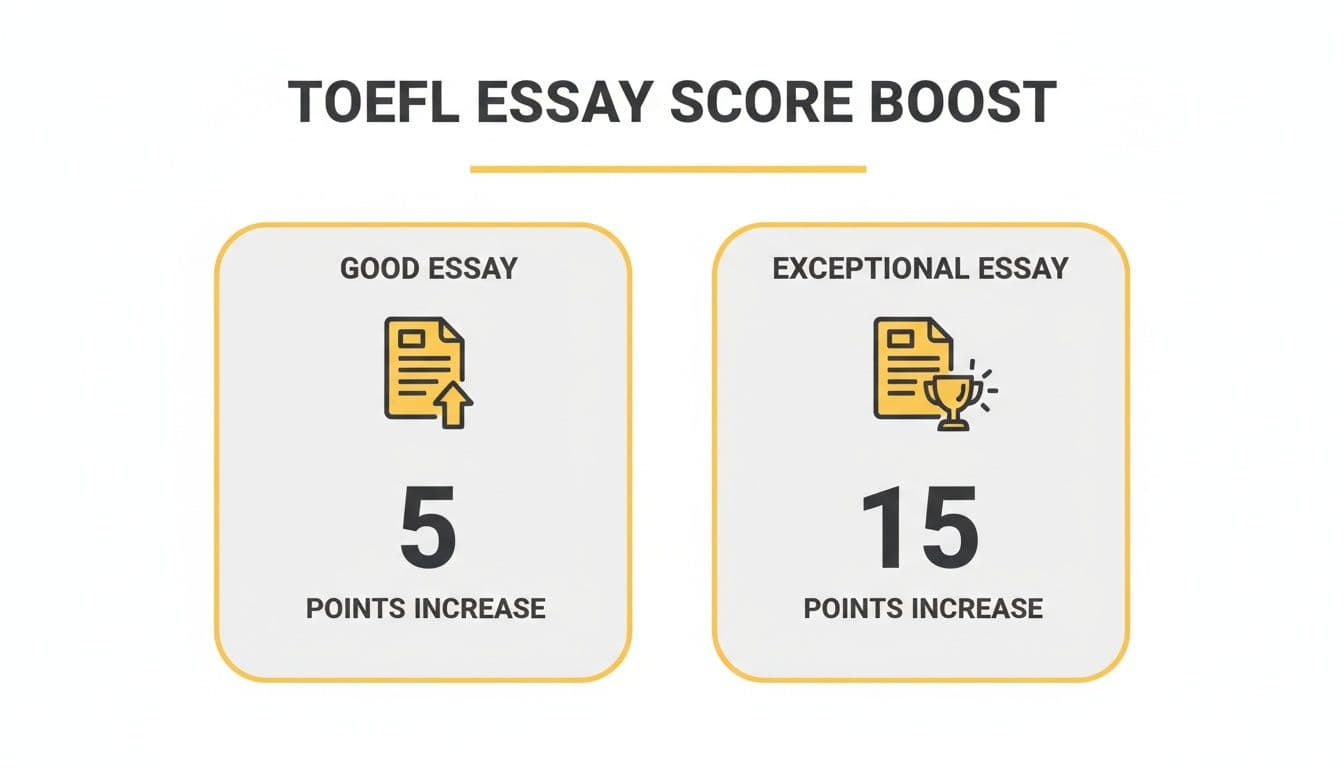
This isn't just theory. Using a counterclaim-rebuttal pair is one of the clearest ways to move your writing from the "good" (3-4 score range) into the "exceptional" (4-5 score range), earning you those top-tier scores.

As you can see, the data shows that graders reward this technique. It’s a direct path to a higher score because it perfectly aligns with the rubric's demand for well-developed and supported ideas.
Why This Matters for Your Score
The numbers don't lie. Official ETS reports reveal that Academic Discussion posts that include rebuttals average a score of 4.3 out of 5. Those without? They average just 3.1 out of 5. That's a huge difference! If you want to dive deeper into what makes an argument truly compelling, check out our guide on evaluation essay topic ideas that demand this exact kind of balanced thinking.
And this skill isn't just for the Academic Discussion.
- Write an Email: You can use it to anticipate and address a potential concern, making your request more persuasive.
- Build a Sentence: This new task tests your ability to connect contrasting ideas with the right conjunctions (like while, although, or however), which is the foundation of a counterclaim.
Mastering this technique is essential because it's woven into the fabric of academic English. You can discover more insights about these findings and how to teach them from Julie Faulkner's blog.
How to Integrate Counterclaims into Each Writing Task
Knowing how to use counterclaims and rebuttals isn't just for a single question. It's a skill that will make your writing stronger across the entire 2026 TOEFL. When you use this technique the right way, you’re showing the graders that you're a sophisticated, critical thinker. You can do this!
Let's break down exactly how to apply it in each task with practical examples.
Academic Discussion Task
This task was practically made for counterclaims and rebuttals. You're jumping into a conversation, and the best way to make a real contribution is by building upon or challenging what others have said. Simply saying "I agree" or "I disagree" won't get you a top score.
Instead, directly address what a classmate wrote. Acknowledge their point first to show you're paying attention, and then pivot to your own argument. This proves you're actively engaged and thinking deeply.
Example Response:
"I see where Maria is coming from when she says that online courses offer more flexibility. It's true that self-paced learning can be a huge benefit for students with busy schedules. However, I think it's also important to consider the lack of spontaneous, face-to-face interaction, which can be crucial for developing collaborative skills and getting immediate clarification on complex topics."
Actionable Tip: Practice by reading a sample post and writing a response that starts with "While I agree with [classmate's name]'s point about..., I believe we should also consider...". You can try this right now with our free practice tool at writing30.com.
Write an Email Task
In this task, you’re usually trying to solve a problem or make a request. A counterclaim here is a smart persuasive tactic. You anticipate the other person's potential concern and address it proactively. This makes your request sound more thoughtful and less demanding.
Example Snippet:
"I understand that the project deadline was set to keep the class on schedule, and I sincerely apologize for any inconvenience my request may cause. Due to an unexpected family emergency, I would be grateful if you would consider granting me a 48-hour extension."
Actionable Tip: When drafting a practice email, ask yourself: "What is one reason this person might say no?" Then, add a sentence that acknowledges that reason before making your request.
Build a Sentence Task
This new task format often tests your ability to link contrasting ideas grammatically. The sentences you build will often contain a claim and a counterclaim. Mastering conjunctions like although, while, whereas, and despite is key.
Example Task:
- A university education is valuable for career prospects.
- It often comes with significant financial debt.
Sample Response:
"Although a university education is valuable for career prospects, it often comes with significant financial debt."
Actionable Tip: Create flashcards with contrasting ideas and practice combining them into a single, grammatically correct sentence using different conjunctions.
Quick-Reference Sentence Starters
When the clock is ticking, having a few phrases ready can be a lifesaver. These sentence starters will help you introduce counterclaims and rebuttals smoothly. For even more sentence stems, check out our guide on TOEFL writing templates.
| Purpose | Example Sentence Starters |
|---|---|
| Introducing a Counterclaim | While it is true that... Some may argue that... It is understandable why some people believe... A common argument against this is that... |
| Delivering a Rebuttal | However, this view overlooks... On the other hand, it is more important to consider... Despite this point, the evidence suggests... Nevertheless, this perspective fails to account for... |
A Step-by-Step Guide to Crafting the Perfect Rebuttal
Knowing you need a rebuttal is the easy part. Writing a strong one under pressure is where practice pays off. A great rebuttal doesn't just say "I disagree." It carefully explains why the opposing view is less convincing than your own. You can learn this with a simple, repeatable method.
Let's walk through a four-step process you can use every time, especially for the Academic Discussion task.

Step 1: State the Counterclaim Clearly
First, show you understand the point you're about to challenge. State the opposing argument fairly. Use a neutral phrase like, "Some argue that..." or "One opposing view is that..." This signals to the scorer that you've understood the other perspective.
Step 2: Acknowledge Its Merit (Briefly)
Next, give a small nod to the other side. A simple phrase like, "It is true that..." or "While this point has some validity..." shows you're a balanced thinker. This quick moment of agreement makes your own argument seem much more credible.
Step 3: Pivot to Your Rebuttal
Now, it's time for the turn. Use a strong transition word like "However," "Nevertheless," or "On the other hand," to pivot back to your own argument. This tells the reader you're about to challenge the point you just acknowledged.
Step 4: Present Your Evidence
Finally, deliver the knockout punch. This is where you explain why your position is stronger by backing it up with specific evidence, an example, or solid logical reasoning. This step is everything. Without it, your rebuttal is just another opinion.
The strength of your rebuttal lives in your evidence. A rebuttal without proof is just another claim. A rebuttal with a concrete example or logical explanation is what earns top scores.
Let's see this 4-step process in action. Imagine an Academic Discussion prompt asking if universities should require students to live on campus for their first year. Another student, Paul, argues against it.
Paul's Post: "Requiring students to live on campus is an unfair financial burden. Off-campus housing is often much cheaper, and this policy forces students into unnecessary debt."
Here’s how you could craft a high-scoring response using our four steps. You can see more examples by browsing our Academic Discussion sample answers.
Your Response (Applying the 4 Steps):
"(1) I understand Paul’s point about the financial burden of on-campus housing. (2) It is true that living off-campus can sometimes be cheaper. (3) However, this view overlooks the significant non-financial benefits that campus housing provides first-year students. (4) For example, students living in dorms have immediate access to academic resources like libraries and tutoring centers and are more likely to join clubs and form strong social networks. These factors are directly linked to higher retention rates and a better overall university experience, which may be more valuable than the initial cost savings."
Common Mistakes to Avoid and How to Fix Them
Executing counterclaims and rebuttals perfectly under pressure is a skill you build through practice. It's easy to make small errors, but the good news is they are very fixable! Let's walk through the most common mistakes and how you can sidestep them.
Mistake 1: The Straw Man Argument
A straw man argument is when you misrepresent or oversimplify an opposing view to make it easier to attack. It’s like arguing against a scarecrow—you'll win, but it doesn't show strong critical thinking.
- Weak: "My classmate thinks technology is always bad for learning, but that's just wrong."
- Strong: "While my classmate raises a valid concern about the potential for distraction with technology, it’s important not to overlook its benefits when used in a structured way."
The Fix: Always restate the other person's point fairly and accurately before you respond. This shows respect and intellectual honesty.
Mistake 2: The Rebuttal Without Evidence
Another common misstep is offering a rebuttal that’s just your opinion. Simply saying "I disagree" or "That's not right" is a dead end. Your job is to show the grader why your perspective is more logical.
- Weak: "Some argue that uniforms limit self-expression. I just don't think that's true."
- Strong: "While some argue that uniforms limit self-expression, this perspective fails to consider that students can channel their individuality into academic and extracurricular achievements, fostering a community identity that is arguably more valuable in a school setting."
The Fix: Always follow your rebuttal with "because..." or "for example...". This forces you to provide the reason or evidence that makes your point strong. For more strategies, check out our guide to improve your TOEFL writing score.
Mistake 3: Awkward Phrasing
Finally, clunky transitions can disrupt the flow of your writing. Your counterclaim and rebuttal should feel like a natural, seamless part of your argument—not a box-checking exercise you awkwardly squeezed in.
The Fix: Practice using transition words from the table above until they feel natural. The secret to making this feel smooth is targeting the logic of the opposing claim. One study on student argumentation found that teaching this specific skill caused the percentage of students reaching a high-level argument to jump from just 15% to 68%. You can read the full research on argumentation levels for a deeper look.
Avoiding these three mistakes is what separates a good score from a great one. Don't worry about being perfect at first; focus on practicing the right way.
How Writing30 AI Helps You Master Counterarguments
Knowing the theory is one thing, but getting targeted practice is how you actually build a top-scoring writing habit. The Writing30 AI tool acts as your personal coach for mastering counterclaims and rebuttals for the 2026 TOEFL. Our platform gives you the repetition you need to make this skill feel like second nature on test day.
The AI instantly analyzes your Academic Discussion posts. It checks whether you’ve included a solid counterclaim and, just as importantly, if you've followed it up with a persuasive rebuttal. It then weighs your logic and supporting details against the official ETS rubric.
Instant, Rubric-Aligned Feedback
If your rebuttal is a bit weak or you missed the chance to add a counterclaim, our AI gives you specific, actionable suggestions. It might offer model phrases or point out where your evidence is falling short, pushing you toward a response that lands in that coveted 4-5 score range.
Here’s a look at the AI feedback in action.
As you can see, the AI highlights the exact sentence where the argument needs more power. It suggests using stronger, more specific evidence to make the point truly convincing. This is the kind of immediate feedback that builds real scoring muscle.
From Theory to Practice
With unlimited practice on Writing30.com, you get the instant feedback loop needed to stop making the same mistakes. The platform helps you drill the skill correctly until it becomes an automatic part of how you write. This is how you build the confidence to perform when the clock is ticking.
Our system is built to help you:
- Identify Missed Opportunities: The AI flags posts where you could have boosted your score by addressing an opposing viewpoint.
- Strengthen Weak Rebuttals: Get concrete examples and sentence stems to make your counterarguments more decisive.
- Improve Logical Flow: Get suggestions for better transition words to connect your counterclaim and rebuttal smoothly.
Stop guessing if your arguments are strong enough. Let our AI guide you through mastering counterclaims and rebuttals so you can walk into the TOEFL feeling prepared and confident.
Frequently Asked Questions
Let's clear up a few common questions test-takers have about counterclaims and rebuttals on the TOEFL. Getting these right can make a huge difference.
How Many Counterclaims Should I Use in the Academic Discussion Task?
Just one. For the Academic Discussion task, quality crushes quantity every single time.
Your goal is to show you can think critically and engage with the other students' ideas. A single, well-explained counterclaim and rebuttal demonstrates far more skill than trying to squeeze in two or three weak ones. Focus on making one powerful point to secure a score in the 4-5 range.
Will I Lose Points if My Rebuttal Is Not Perfect?
No, not at all. You've got this! The graders are looking for a good-faith effort and clear critical thinking, not perfection. An imperfect but logical attempt to address an opposing view will always score higher than a response that just ignores other perspectives.
The key is showing you can grapple with different ideas. Don't let the fear of making a mistake stop you. Even a basic counterclaim and rebuttal proves you have the advanced reasoning skills the TOEFL is looking for.
Can I Use Counterclaims in the Write an Email Task?
Yes, and you absolutely should! It's a fantastic technique for making your email more persuasive and professional.
When you're making a request, you can anticipate a potential objection and address it before they even think of it. For example, you might write, "I know that schedules are tight this time of year..." and then explain why your request is still reasonable. This shows you're considerate and makes it much harder for them to say no.
Ready to stop guessing and start scoring? Turn theory into practice with instant, rubric-aligned feedback on your counterclaims and rebuttals. Try our free practice tools today at Writing30.
Ready to Practice?
Try all 3 TOEFL 2026 writing tasks with instant AI feedback.
Tags
Ready to Improve Your TOEFL Writing?
Get instant AI-powered feedback on your TOEFL writing. Practice with real prompts and see your score improve.
Try Writing30 AI