Master the TOEFL Writing Section: Topic Ideas & Strategies for 2026
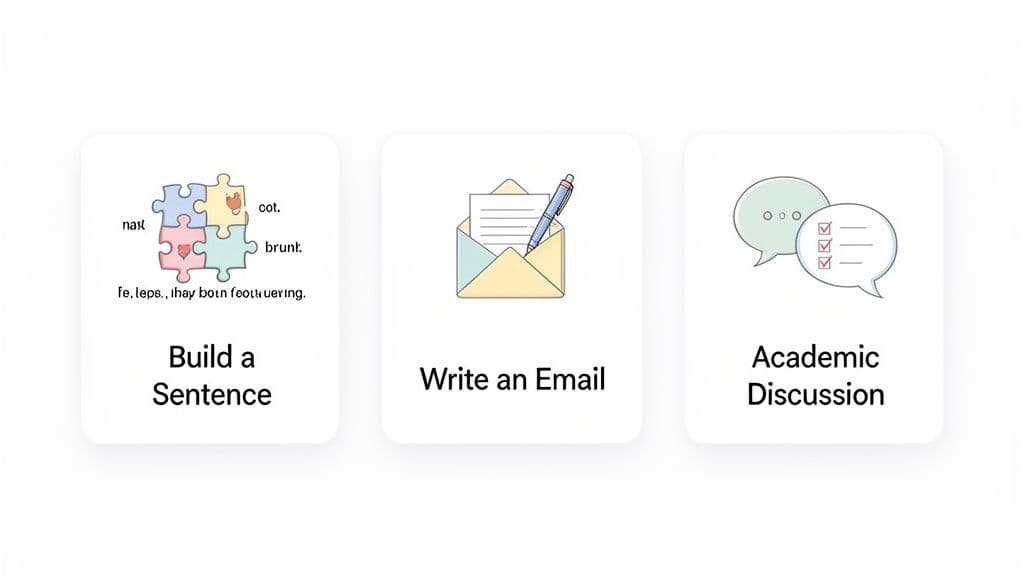
Feeling anxious about the TOEFL 2026 writing section? You're not alone. The format, with its distinct Build a Sentence, Write an Email, and Academic Discussion tasks, demands smart, focused preparation. We understand that your score is important, and with the right approach, you can feel confident and prepared. Simply finding a random prompt online isn't enough; you need practice that directly targets the skills ETS raters evaluate, like grammatical accuracy, vocabulary range, and clear organization. That's why this guide is different. It's built to give you a strategic advantage by providing specific, actionable evaluation essay topic ideas that mirror the critical thinking required on test day.
This article offers more than just a list of topics. We'll explore ten structured prompts designed for the 2026 TOEFL, each one helping you practice a crucial aspect of high-scoring writing. You will learn to assess different preparation methods, from AI feedback tools to time management strategies, and articulate your judgment clearly and persuasively—just as you'll need to in your future university courses.
For each topic, we provide:
- A clear, focused prompt to guide your writing.
- A sample response to help you start strong.
- Actionable tips you can practice immediately to improve your score.
- Key vocabulary to demonstrate your command of academic English.
By working through these topic ideas, you'll build the confidence and skills needed to excel in every part of the TOEFL writing section. Let’s get started on the path to your target score. You've got this!
1. Evaluating AI-Powered Writing Feedback Tools for TOEFL Preparation
This topic idea requires you to assess the effectiveness of an AI writing feedback platform for your TOEFL preparation. Instead of just reviewing features, your goal is to create a detailed judgment based on specific criteria. Does the tool’s feedback accurately reflect the official ETS scoring rubrics for the 2026 TOEFL format?
Your evaluation should connect the AI’s suggestions directly to scoring dimensions. For instance, if an AI flags a sentence in an Academic Discussion response for being "wordy," your essay should analyze whether that correction improves Linguistic Features (Score Range 1-5) by making the language more precise and concise, a key factor for scoring well. Similarly, for the Write an Email task, you would assess if the AI's tone suggestions help you meet the task requirements effectively.
How to Structure Your Evaluation
A strong essay would move beyond a simple "good" or "bad" verdict. It would present a balanced argument supported by evidence.
- Criterion 1: Rubric Alignment: Does the AI score your practice essays (like the Academic Discussion) on the same 1-5 scale as ETS? Evaluate if its feedback on Development and Linguistic Features aligns with official descriptions.
- Criterion 2: Actionable Feedback: Assess the quality of the recommendations. Are they generic ("improve grammar") or specific ("This sentence contains a subject-verb agreement error: 'The professor mention' should be 'The professor mentions'")?
- Criterion 3: Impact on Score: Submit an initial draft, apply the AI's feedback, and resubmit. Your essay can then evaluate the score change as a measure of the tool's effectiveness.
Sample Response Snippet: "While some grammar checkers are useful, a dedicated TOEFL tool like Writing30 provided a more direct path to a higher score. For my Academic Discussion practice, it suggested replacing 'a lot of people think' with 'a prevalent perspective is,' which directly improved my 'Linguistic Features' score by demonstrating a stronger command of academic vocabulary. This specificity is crucial for targeted improvement."
Platforms like Writing30 are designed specifically for the TOEFL, offering rubric-aligned feedback that simulates the real test experience. To practice your own evaluation, you can check an essay and analyze how the automated feedback helps improve your response for all three writing tasks. This provides concrete evidence for your essay.
2. Comparing TOEFL 2026 Writing Task Formats: Build a Sentence, Email, and Academic Discussion
This topic idea challenges you to analyze the three distinct writing tasks in the TOEFL 2026 format: Build a Sentence, Write an Email, and Academic Discussion. Your essay should go beyond describing each task and instead present a well-supported judgment about their relative difficulty and the most effective preparation strategies for each.

Your evaluation needs to connect each task format to specific challenges and skills. For example, you might argue that the Academic Discussion task is the most challenging because it requires synthesizing information from a professor's post and another student's comment under a tight 10-minute time limit. Your essay would then assess how this format tests Development (contributing a relevant idea) and Linguistic Features (using precise academic language) more intensely than the other two tasks.
How to Structure Your Evaluation
A successful essay will offer a nuanced comparison, using clear criteria to weigh the demands of each task. Avoid a simple ranking; instead, analyze the unique purpose and challenges of each format.
- Criterion 1: Cognitive Load: Evaluate the mental effort required. The Build a Sentence task primarily tests grammatical accuracy with speed. The Academic Discussion tests critical thinking and synthesis under pressure.
- Criterion 2: Skill Application: Assess which real-world academic skills each task measures. For instance, evaluate how well the Write an Email task simulates authentic university communication, testing for appropriate tone, register, and clear purpose.
- Criterion 3: Preparation Strategy: Compare the most effective ways to study for each format. Is targeted grammar practice best for Build a Sentence, while timed, integrated practice is necessary for the Academic Discussion?
Sample Response Snippet: "While the Build a Sentence task appears simplest, its rapid-fire format demands automatic grammatical recall. In contrast, the Write an Email task requires a different skill: audience awareness. For example, when writing to a professor to ask for an extension, it is essential to use a formal yet polite tone, a skill directly applicable to university life. Therefore, the email task is a better measure of a student's overall communication readiness."
To gather evidence for your essay, practice each format separately. You can find detailed strategies and examples, especially for the challenging Academic Discussion, which will help you build your argument. To learn more about this task, check out these Academic Discussion tips for practical guidance.
3. Evaluating Vocabulary Expansion Strategies in TOEFL Writing Practice
This topic idea focuses on assessing different methods for expanding your academic vocabulary and their direct impact on your TOEFL writing score. Your essay's goal is to judge which strategies—such as using word frequency lists, flashcards, or AI-driven suggestions—are most effective for improving lexical diversity within timed writing tasks like the Academic Discussion.
Your evaluation must connect specific strategies to the Linguistic Features scoring dimension of the TOEFL rubric. For example, if you use an AI tool like writing30.com to find a synonym for "important," your essay should analyze whether the suggested word, like "pivotal" or "critical," fits the context of your sentence and genuinely elevates the academic tone. A simple word swap isn't enough; the change must add precision and sophistication.
How to Structure Your Evaluation
A successful essay will deliver a nuanced judgment on the practical application of different vocabulary-building techniques for the 2026 TOEFL format.
- Criterion 1: Contextual Appropriateness: Evaluate whether a strategy helps you choose the right word for the right situation. Does a synonym database explain the subtle difference between "suggest" and "insinuate," or does an AI tool provide examples?
- Criterion 2: Efficiency and Retention: Assess how quickly a method helps you learn and recall words during a timed test. Compare rote memorization from lists versus contextual learning through reading academic articles.
- Criterion 3: Impact on Fluency: Your essay should analyze if a particular strategy disrupts your writing flow. Does searching for the "perfect" word cause you to write more slowly, or does it become a natural part of your process?
Sample Response Snippet: "Although flashcards helped me memorize definitions, they did not improve my ability to use words correctly under pressure. A more effective strategy was using a practice tool that provided contextual synonym suggestions for my Academic Discussion post. This allowed me to immediately see how a word like 'integral' could replace 'very important' to make my argument sound more academic and precise, directly boosting my Linguistic Features score."
To gather evidence for your paper, you can actively test these methods. Building a system for active recall is also important; you can discover techniques for how to remember vocabulary to make your study sessions more productive.
4. Assessing Grammar Error Detection Accuracy in AI Writing Tools
This topic idea challenges you to judge how accurately AI grammar checkers identify errors common in TOEFL writing. The core task is to create a detailed assessment of an AI tool’s ability to correctly diagnose issues like subject-verb agreement, article usage (a/an/the), and verb tense consistency, all of which are critical for a high Linguistic Features score on the TOEFL.

Your evaluation essay must connect the AI's diagnostic performance directly to its impact on your potential score. For example, if you write, "The professor mention a new theory," a good AI should not just flag "mention" but also classify it as a subject-verb agreement error. This level of detail helps you learn the rule, not just fix one mistake, which is vital for the Build a Sentence task.
How to Structure Your Evaluation
A compelling essay will present a nuanced judgment based on clear evidence. It should evaluate the tool's precision rather than just its feature set.
- Criterion 1: Error Categorization Accuracy: Does the AI correctly label the type of error? Evaluate if it can distinguish between a preposition mistake ("interested on") and an article omission ("I saw beautiful painting"), as these reflect different common grammar mistakes that affect your score.
- Criterion 2: False Positives and Negatives: Assess how often the tool flags correct grammar as an error (false positive) or misses an actual mistake (false negative). High rates of either can mislead a student.
- Criterion 3: Alignment with Human Raters: Compare the AI's feedback on a sample essay with feedback from a human tutor or an experienced peer. Your essay can then evaluate the degree of alignment as a measure of the tool's reliability.
Sample Response Snippet: "While basic spell-checkers found typos, the AI at writing30.com was more helpful because it accurately identified a subject-verb agreement error in my practice sentence. More importantly, it explained the rule, which helped me avoid the same mistake in the next timed practice. This level of specific, educational feedback is essential for moving from a score of 3 to a 4 or 5 on Linguistic Features."
5. Evaluating Test Preparation Platforms: Features, Pricing, and Score Improvement Claims
This evaluation essay topic idea challenges you to act as a critical consumer, assessing the real-world value of different TOEFL preparation platforms. Your essay will go beyond a simple review by creating a detailed judgment on which platforms offer the best return on investment, based on specific, measurable criteria. Does an expensive subscription genuinely translate to a higher TOEFL score?
Your evaluation must connect a platform’s offerings directly to tangible outcomes. For example, when comparing two platforms, your essay should analyze their features against the 2026 TOEFL format requirements. If a platform offers extensive video lessons but its practice questions don't align with the new Build a Sentence task, you could argue that its value is diminished for current test-takers compared to a tool providing specific, rubric-aligned feedback on all three writing tasks.
How to Structure Your Evaluation
A successful essay will present a clear, evidence-based argument comparing the value propositions of at least two platforms.
- Criterion 1: Cost vs. Value: Analyze the pricing models. Is a platform's value justified by its cost? Calculate the cost-per-practice submission to compare platforms. A service offering unlimited checks might be more valuable than one with a limited number of full tests.
- Criterion 2: Feature Relevance: Evaluate how well the platform's features align with the actual demands of the 2026 TOEFL. Does it offer specific practice and feedback for the Write an Email and Academic Discussion tasks?
- Criterion 3: Verified Score Improvement: Assess the credibility of score improvement claims. Look for testimonials that mention specific score increases. Weigh marketing hype against the evidence provided by rubric-aligned scoring.
Sample Response Snippet: "Although Platform A offered many video lessons, its generic feedback was not as useful as Platform B's targeted approach. Platform B, using a tool like writing30.com, provided an estimated score for my Academic Discussion post and linked its suggestions directly to the official ETS rubric. This made it clear how improving a specific area, like my use of transition words, could raise my 'Development' score, offering a better return on my study time."
Platforms like Writing30 offer transparent pricing with weekly and discounted multi-month plans, allowing you to assess their value without a long-term commitment. To gather concrete evidence for your essay, you can check an essay and analyze how its feedback directly addresses scoring dimensions, then compare that experience and cost to other available platforms.
6. Analyzing Time Management Strategies During Timed TOEFL Writing Tasks
This topic idea asks you to assess the effectiveness of different time management techniques for completing the TOEFL writing tasks. Your goal is to argue which strategies, like a strict plan-write-edit split, are most effective for balancing speed and quality under the pressure of the 2026 TOEFL format's time limits. Don't worry, finding a rhythm that works for you is a key part of preparation.
Your evaluation must be grounded in measurable outcomes. For instance, when analyzing the 10-minute Academic Discussion task, you could compare a 2-minute planning phase versus a 1-minute one. Your essay would then judge which approach leads to a more developed and well-supported response, directly impacting the Development score (rated 1-5). Similarly, for the Write an Email task, you would assess whether dedicating the final two minutes to editing consistently improves Linguistic Features by catching more errors.

How to Structure Your Evaluation
A successful essay will present a clear verdict on a specific time management method, using your own timed practice sessions as evidence.
- Criterion 1: Task Completion Rate: Did the strategy help you finish the task within the time limit? Evaluate if you consistently completed all parts of the prompt for the Write an Email task.
- Criterion 2: Quality of Output: Assess the writing quality. Did rushing the planning phase lead to a disorganized Academic Discussion response? Did a longer editing phase result in a measurably higher score?
- Criterion 3: Stress and Cognitive Load: Evaluate the mental impact. Does a rigid minute-by-minute plan increase anxiety, or does it provide a reassuring structure? The best strategy reduces pressure and allows for clearer thinking.
Sample Response Snippet: "I initially thought that spending more time writing would be best for the 10-minute Academic Discussion. However, after several practice attempts, I found that dedicating a full two minutes to outlining my main point and supporting reason consistently resulted in a higher 'Development' score. This structured approach, though it left less time for writing, produced a more logical and persuasive contribution to the discussion."
Simulating exam conditions is critical for this topic. Using a platform with timed mock tests, like those on writing30.com, allows you to practice against the official clock. This provides the concrete data needed to evaluate which strategy works best for you.
7. Evaluating Coherence and Organization Feedback in Academic Writing Assessment
This topic idea asks you to judge the quality of feedback on essay structure and logical flow, which are central to a high TOEFL writing score. Your task is to assess how well an AI or human feedback system identifies organizational weaknesses in your writing. Does the feedback help you improve paragraph structure and argument flow in a way that aligns with ETS rubric expectations for the Development score?
Your evaluation should connect the feedback directly to scoring criteria. For instance, if an AI tool suggests adding a transition word like "Furthermore" to your Academic Discussion post, your essay should analyze whether this improves the logical link between ideas. For the Write an Email task, you would assess if feedback on paragraphing helps you present your request and reasons in a more organized, easy-to-follow manner, fulfilling the task requirements.
How to Structure Your Evaluation
A successful essay will provide a detailed judgment on whether the feedback effectively improves your essay’s organization, supported by clear examples.
- Criterion 1: Rubric Alignment: Does the feedback address the specific organizational elements mentioned in the ETS rubrics? Evaluate if suggestions about topic sentences or transitions directly relate to scoring well in the Development dimension (rated 1-5).
- Criterion 2: Clarity and Actionability: Assess whether the feedback is specific enough to be useful. Is it a vague comment like "improve your flow," or does it pinpoint an exact problem, such as: "This paragraph lacks a clear topic sentence, making your main point difficult to identify"?
- Criterion 3: Impact on Readability and Score: Write a draft, apply the organizational feedback, and then have it re-scored. Your essay can analyze whether the changes made your argument easier to follow and if it resulted in a higher score.
Sample Response Snippet: "A general grammar checker noted a lack of transitions, but Writing30's feedback was more effective. It explained that my second paragraph in the Academic Discussion post should logically precede the first to build a stronger argument. After reordering my points as suggested, my 'Development' score increased from a 3 to a 4 because the argument was more persuasive and easier to follow."
Tools like Writing30 offer AI feedback that specifically targets organizational weaknesses. To gather evidence for your essay, you can check an essay and analyze how the automated feedback helps you structure your ideas more logically for the Academic Discussion and Write an Email tasks.
8. Assessing the Effectiveness of Personalized Learning Paths and Adaptive Feedback Systems
This topic idea requires you to judge how well an adaptive learning platform personalizes its feedback to speed up your TOEFL writing improvement. Your essay will go beyond a simple review, focusing on whether a system's ability to track recurring mistakes and create custom study plans is more effective than generic advice.
Your analysis should connect the personalized feedback directly to the ETS scoring rubrics for the 2026 TOEFL format. For instance, if an AI generates a personalized "feedback card" showing you consistently misuse transition words, your essay would evaluate if practicing with this targeted insight improves your Development score on Academic Discussion tasks. Likewise, you could assess if a system's focus on your common formality errors helps you meet the requirements for the Write an Email task more effectively.
How to Structure Your Evaluation
A strong essay will argue for or against the value of personalization, using specific data from your practice sessions as evidence.
- Criterion 1: Accuracy of Pattern Identification: Does the system accurately identify your true recurring mistakes? Evaluate if the personalized feedback reflects genuine weak areas after you have submitted several practice responses.
- Criterion 2: Quality of Recommendations: Are the customized study suggestions actionable? Assess if the platform recommends specific exercises or concepts that directly address your identified weaknesses, such as a mini-lesson on article usage (a/an/the).
- Criterion 3: Measurable Improvement: Track your progress. Does focusing on the platform’s recommended weak areas lead to a noticeable score increase over time? Compare your initial scores to scores after several weeks of following the personalized path.
Sample Response Snippet: "While generic feedback identified isolated errors, the personalized path at writing30.com was more effective. It revealed a recurring pattern of weak topic sentences in my Academic Discussion posts. By focusing my practice on this specific skill, I was able to measurably improve my 'Development' score from a consistent 3 to a 4 across all my practice essays."
Platforms like Writing30 are built to provide this level of personalization. To gather evidence for your essay, you can check an essay and begin building your performance profile to see how adaptive feedback helps you target your unique areas for improvement.
9. Evaluating the Role of Sample Essays and Model Responses in Writing Improvement
This topic idea requires you to assess how using high-scoring sample essays impacts a student's TOEFL writing improvement. Your goal is to create a judgment on which methods of using them are most effective. Does analyzing the structure of a model Academic Discussion response lead to a higher score than just memorizing its vocabulary?
Your evaluation should connect the study of sample essays directly to the ETS scoring criteria. For instance, if you analyze a model Write an Email response that scores a 5, your essay should examine how its tone, organization, and phrasing meet the task requirements. You would then argue whether deconstructing such examples is a more effective preparation strategy than simply writing many practice emails without guidance.
How to Structure Your Evaluation
A successful essay on this topic presents a nuanced argument about the how and why behind the effectiveness of sample responses.
- Criterion 1: Method of Analysis: Compare different learning approaches. Is it more effective to analyze a sample's structure, extract its advanced vocabulary, or compare it side-by-side with your own attempt?
- Criterion 2: Transferable Skills: Evaluate whether studying a sample helps a writer internalize principles they can apply to any prompt. Does it teach flexible organization for the Academic Discussion task, or does it encourage rigid copying?
- Criterion 3: Impact on Weaknesses: Assess if model responses are more useful for improving "Development" (ideas and support) or "Linguistic Features" (grammar and vocabulary). Analyze a sample to see how it balances both dimensions.
Sample Response Snippet: "While passively reading ten sample essays was somewhat helpful, a more effective strategy was to write my own response first, then compare it side-by-side with a single high-scoring model. This active comparison allowed me to identify specific gaps in my argument and language. For example, I noticed the model essay used a clear counter-argument, which I had omitted. Adding this element to my own writing directly improved my 'Development' score."
Platforms often provide practical templates and annotated examples derived from successful essay patterns. To gather evidence for your own paper, you can study these expert-written TOEFL Writing samples and analyze how their structure and language choices lead to a high score.
10. Evaluating Scalability and Accessibility of Online TOEFL Writing Preparation for Diverse Learner Populations
This topic idea asks you to judge how well an online TOEFL writing platform serves a wide range of students. Your assessment should go beyond features and analyze the platform's commitment to accessibility for learners with different needs, including students from various socioeconomic backgrounds and those at different proficiency levels.
Your evaluation must connect a platform’s design choices to its real-world impact. For example, if a platform offers flexible pricing plans, your essay should analyze how this feature makes quality TOEFL preparation accessible to more students. Similarly, if a tool offers different levels of feedback, you would evaluate its effectiveness for both beginners who need foundational help and advanced writers aiming for a top score in the Academic Discussion.
How to Structure Your Evaluation
A compelling essay will present a nuanced judgment based on clear, equity-focused criteria. It should argue how well the platform's design promotes equal opportunity for all TOEFL test-takers.
- Criterion 1: Economic Accessibility: Does the platform offer varied pricing, such as flexible weekly plans versus more affordable multi-month packages? Investigate if it provides financial aid or regional discounts. For instance, Writing30's multiple subscription tiers cater to different budgets.
- Criterion 2: Technical and Geographic Accessibility: Evaluate the platform's technical demands. Does it function well on older devices or low-speed internet? Is it mobile-friendly? This is critical for learners who rely on smartphones.
- Criterion 3: Learner Support and Inclusivity: Assess the support systems. Does the platform’s interface feel intuitive for non-native English speakers? Consider how it supports both beginners who need help with basic sentence structure for the Build a Sentence task and advanced writers refining complex arguments.
Sample Response Snippet: "While some platforms require expensive, long-term commitments, Writing30's multi-tiered pricing model and rubric-aligned feedback present a more equitable solution. Its flexible weekly plans and instant, automated feedback make high-quality practice accessible to students with limited budgets and time, addressing both the financial and pedagogical needs of a diverse global student population."
To gather evidence, you can explore platforms and test their features firsthand. For example, you could visit a site to check an essay and see how its feedback system caters to different skill levels, providing concrete material for your evaluation.
10-Topic Comparison: TOEFL Writing Evaluations
| Topic | Implementation complexity | Resource requirements | Expected outcomes | Ideal use cases | Key advantages |
|---|---|---|---|---|---|
| Evaluating AI-Powered Writing Feedback Tools for TOEFL Preparation | Medium–High (AI models + rubric alignment) | Cloud compute, annotated corpora, continuous updates, internet | Fast rubric-aligned feedback; measurable score gains (partial) | High-volume practice; self-study with instant correction | Instant, scalable feedback; progress tracking; cost-effective vs tutors |
| Comparing TOEFL 2026 Writing Task Formats: Build a Sentence, Email, Academic Discussion | Low–Medium (analysis and template creation) | ETS materials, sample responses, curriculum design | Clear task expectations; targeted practice plans | Curriculum design; focused exam-format practice | Task-specific templates; clarity on relative difficulty |
| Evaluating Vocabulary Expansion Strategies in TOEFL Writing Practice | Low–Medium (tool integration & lexica) | Vocabulary databases, synonym engines, corpora | Broader lexical range; reduced repetition in responses | Lexical-score improvement; targeted vocabulary drills | Real-time synonyms; contextual word suggestions |
| Assessing Grammar Error Detection Accuracy in AI Writing Tools | Medium–High (error taxonomy + ML) | Annotated grammar corpora, rule-sets, model validation | Higher grammatical accuracy; explanatory feedback for learning | Fixing recurring grammar mistakes; editing practice | Detailed error categorization; severity-ranked suggestions |
| Evaluating Test Preparation Platforms: Features, Pricing, and Score Improvement Claims | Medium (product comparison + analytics) | Platform feature audits, pricing models, user performance data | Informed purchasing decisions; cost-per-practice insights | Choosing subscription plans; ROI-focused preparation | Transparent pricing, mock exams, verified improvement evidence |
| Analyzing Time Management Strategies During Timed TOEFL Writing Tasks | Low–Medium (timers + analytics) | Countdown timers, logging, performance metrics | Improved pacing and completion rates under time pressure | Timed mock tests; speed and editing practice | Realistic timed simulation; data-driven pacing guidance |
| Evaluating Coherence and Organization Feedback in Academic Writing Assessment | High (discourse analysis & argument mapping) | Annotated essays, discourse models, expert rubrics | Better paragraph structure, transitions, and logical flow | Macro-level essay revision; argumentation skill building | Paragraph-level diagnostics; restructuring suggestions |
| Assessing the Effectiveness of Personalized Learning Paths and Adaptive Feedback Systems | High (adaptive algorithms & tracking) | User history, ML personalization, dashboards | Faster targeted improvement; efficient study focus | Long-term remediation; individualized study plans | Personalized feedback cards; prioritized learning paths |
| Evaluating the Role of Sample Essays and Model Responses in Writing Improvement | Low (curation and annotation) | High-quality exemplars, expert annotations, templates | Clear models of high-scoring responses; transferable patterns | Learning structure and vocabulary via imitation/analysis | Annotated exemplars; side-by-side comparisons |
| Evaluating Scalability and Accessibility of Online TOEFL Writing Preparation | Medium (localization + multi-platform support) | Mobile compatibility, low-bandwidth modes, multilingual UI | Wider reach across geographies and abilities; increased equity | Serving diverse, low-resource, or time-constrained learners | Flexible access, affordable plans, offline/low-bandwidth options |
Turn Your Knowledge into a High Score
You've just explored a curated collection of topic ideas designed to do more than just fill a page. They are strategic practice tools, each one aimed at building the specific analytical and writing skills required for the TOEFL 2026 exam. This approach is powerful because it mirrors the critical thinking you’ll need on test day for all three tasks: Build a Sentence, Write an Email, and Academic Discussion. Your ability to evaluate, judge, and justify is constantly being tested.
Key Takeaways for Your TOEFL Journey
As you move forward, keep these core principles at the forefront of your practice. Remember, you are capable of achieving your goal.
- Evaluation is a Skill, Not Just a Topic: The real value here lies in practicing the act of judgment. You are learning to create clear criteria, gather evidence, and deliver a logical, well-supported verdict. This skill is directly transferable to all TOEFL writing tasks.
- Specificity Wins: A high-scoring response is never vague. When you evaluate something, your critique must be grounded in specific examples. Instead of saying a tool is "good," explain that it "accurately identified 9 out of 10 subject-verb agreement errors." This detail shows strong command.
- Structure is Your Skeleton: Your ideas need a strong framework. A clear main point, logical organization, and smooth transitions are non-negotiable, especially for the Academic Discussion and Write an Email tasks.
Your Actionable Next Steps
Knowledge without action is just potential. To turn these concepts into a tangible score increase, you must apply them consistently. Here is a simple plan to get started immediately:
- Choose One Topic: Select one of the evaluation topics from this article that feels most relevant to your current needs.
- Set Your Criteria: Before you write, spend five minutes brainstorming your evaluation criteria. What makes a strategy "effective" for you?
- Practice Under Timed Conditions: Set a timer and write a response. Simulating exam pressure is crucial for building both speed and accuracy. The goal is progress, not perfection.
- Seek Immediate, Specific Feedback: This is the most critical step. You need to know precisely where you can improve. Using a tool like writing30.com provides instant, rubric-based feedback to guide you.
By consistently practicing with these targeted topic ideas, you are building the confidence and competence to excel not only on the TOEFL but also in your future academic career.
Don't let your hard work go unmeasured. The best way to improve is with immediate, score-based feedback that mirrors the official TOEFL rubric. Writing30 AI is designed specifically for the 2026 TOEFL format, providing instant analysis and actionable suggestions on your practice essays. Try your first task now and get your estimated score in seconds at Writing30 AI.
Ready to Practice?
Try all 3 TOEFL 2026 writing tasks with instant AI feedback.
Tags
Ready to Improve Your TOEFL Writing?
Get instant AI-powered feedback on your TOEFL writing. Practice with real prompts and see your score improve.
Try Writing30 AI