How long is toefl test: 2026 Timing Guide to Plan Your TOEFL
Let's get straight to the point: for the 2026 format, the entire TOEFL iBT test is just under two hours long.
Taking on the TOEFL can feel daunting, but you've got this. Knowing the exact timing isn't just about reducing test-day anxiety; it’s about building a winning strategy. The whole exam is now a single, focused session with no scheduled breaks, which makes your personal time management absolutely critical. Let's walk through it together.
Your Quick Guide to the 2026 TOEFL Test Length
This streamlined, sub-two-hour format is a major change from older versions of the test, designed to help you stay focused from the first question to the last. This shorter duration, effective from January 21, 2026, marks a significant shift in how the exam is structured. You can find more details on the history of the TOEFL's length on a great resource like Magoosh.com.
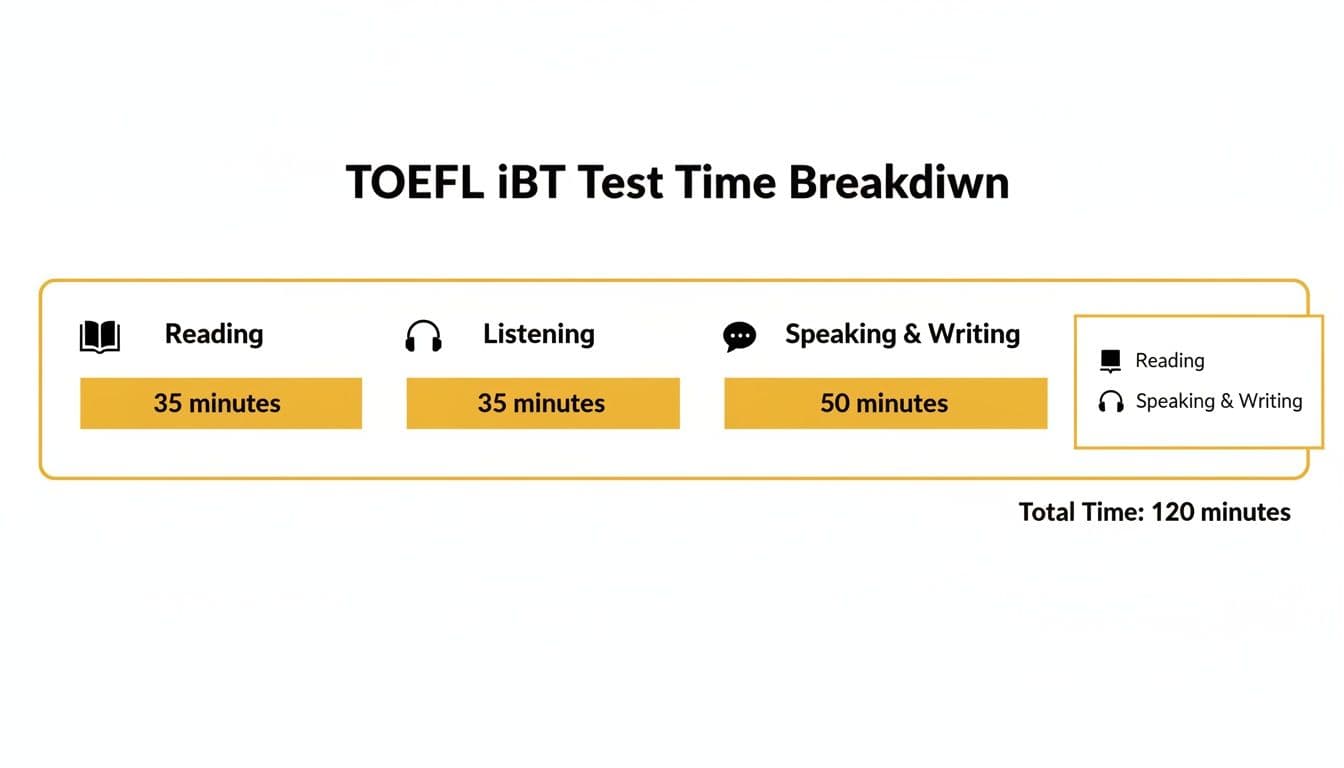
The image below gives you a quick visual breakdown of how that time is split between the main skill areas.

Seeing it mapped out like this helps you mentally prepare for the pace of the exam. For an even more precise look, here's a table with the specific timing and question counts for each section of the 2026 format.
TOEFL iBT Test Sections and Timing (2026 Format)
This table shows exactly what to expect in each part of the under-two-hour TOEFL iBT.
| TOEFL Section | Approximate Time | Number of Questions/Tasks |
|---|---|---|
| Reading | 35 minutes | 20 questions |
| Listening | 36 minutes | 28 questions |
| Speaking | 16 minutes | 4 tasks |
| Writing | 29 minutes | 3 tasks |
Memorizing this breakdown is the first step toward mastering the test. With this timing in mind, you can practice each section under realistic conditions and walk into the exam with no surprises. You can do this!
A Detailed Breakdown of Each Section's Timing

Okay, you've got the big picture. Now, let’s get into the minute-by-minute reality of test day. Succeeding on the TOEFL isn't just about English; it's about mastering small windows of time. Remember, the exam is a continuous sprint with no scheduled breaks, but with practice, this is a race you can win.
The test kicks off with Reading and Listening, two sections designed to push your comprehension skills under the clock. You get 35 minutes to tackle 20 questions in the Reading section, followed immediately by 36 minutes for the Listening section's 28 questions.
Speaking Section Timing
Once you finish Listening, the test moves straight into the Speaking tasks. This is the shortest section by far, clocking in at only 16 minutes. You’ll have to complete four distinct speaking tasks designed to measure how clearly and effectively you can express yourself on the spot. The pace is fast, so practice helps you think on your feet.
Writing Section Timing
The final leg of the exam is the Writing section, which you'll have 29 minutes to complete. This section is especially intense because it features three task types. Knowing the timing for each one is absolutely critical to finishing strong.
Build a Sentence: You’ll get roughly 6-7 minutes in total to complete 8-10 of these items. Each one asks you to construct a perfect sentence from a set of scrambled words, testing your command of English grammar under pressure.
- Actionable Tip: Don't get stuck! If a sentence is tricky, make your best guess and move on. It’s better to complete all items than to get a perfect score on only a few.
Write an Email: You are given a strict 9 minutes for this task. The goal is to write a professional or academic email of around 100 words, proving you can communicate clearly in a common real-world context.
Academic Discussion: You have 10 minutes for this final task. Here, you need to write a post of at least 100 words that contributes to an online class discussion. This shows you can form and support an academic argument.
Pacing in the Writing section is everything. A classic mistake is spending too much time perfecting the email, leaving you scrambling on the more complex Academic Discussion task. You must practice these tasks under timed conditions to avoid this trap.
To build the muscle memory and confidence you need, you have to simulate these exact conditions. Our free practice tools at Writing30.com let you drill all three new writing tasks with an on-screen timer that mimics the real exam.
Why the TOEFL Test Is Now Shorter
If you’ve been following the TOEFL, you've probably noticed it keeps getting shorter. This isn't random. The shift to today’s lean, under-two-hour format is the direct result of years of feedback from students just like you, as well as a need to stay competitive.
Think of it like a software update. The core function—measuring your English proficiency—hasn't changed, but the user experience has been completely overhauled. ETS, the organization behind the TOEFL, streamlined the test to make it less of a marathon and a lot more approachable.
A Journey From Marathon to Sprint
This wasn't always the case. Back around 2005-2006, when the TOEFL moved from its paper version to the internet-based test (iBT), the duration ballooned from about two hours to a grueling four hours.
This marathon length put the TOEFL at a serious disadvantage. Many test-takers understandably started gravitating toward shorter alternatives like the IELTS. This history shows the current, shorter format is a deliberate move designed with your performance in mind. You can read more about these past changes on TOEFL Resources.
The key takeaway is that a shorter test values efficiency over endurance. It's designed to give you the best possible environment to demonstrate your true abilities without the added stress of a four-hour marathon.
By cutting down the test time, ETS helps you stay sharp and focused from the first question to the last, minimizing the mental fatigue that can sink your score.
These improvements also mean your preparation strategy needs to be just as efficient. For a deep dive into what the latest updates mean for you, check out our guide to the TOEFL 2026 changes and how to adjust your study plan.
Ultimately, the test’s evolution is a huge win for students. It proves a commitment to a fairer, more user-friendly experience where your English skills—not your stamina—are what truly count.
Mastering the Writing Section Under Pressure

The Writing section is where your time management gets its biggest test. You get just 29 minutes to handle three entirely different tasks. Success here isn't just about what you write—it's about how you manage every second. Don't worry, we'll break it down into manageable steps.
Thinking of it as a single 29-minute block is a recipe for disaster. You need to see it as three mini-tests. This mental shift helps you focus on one goal at a time without feeling overwhelmed.
Strategies for Each Writing Task
The whole game is about allocating your time with precision and sticking to the plan. Each task demands a different mindset and pacing. Wasting even a couple of minutes can seriously jeopardize your overall Writing score.
1. Build a Sentence (6-7 minutes total): You’ll face 8-10 of these quick tasks. Your goal is to arrange scrambled words into a grammatically correct sentence.
- How to Practice: Find any English sentence and mentally scramble it, then put it back together. This trains your brain to see grammatical patterns quickly.
- Scoring Focus: The rubric for this task type focuses on grammatical accuracy and proper sentence formation. Each correct sentence adds to your score.
2. Write an Email (9 minutes): This task asks you to write a brief, purposeful email (around 100 words).
- Example Response: Let's say you need to email a professor about a missed class. A good response would be concise and clear:
"Dear Professor Smith, I am writing to inform you that I was unable to attend today's lecture due to a medical appointment. I have already reviewed the slides on the course website. Could you please let me know if there were any crucial announcements I missed? Thank you for your understanding. Sincerely, [Your Name]."
- Actionable Tip: Start by clearly stating your purpose. Then, provide a brief, polite explanation or request. A quick proofread in the final minute is essential.
3. Academic Discussion (10 minutes): This task carries significant weight. You'll read a professor's question and two student responses, then write your own contribution (at least 100 words).
- Example Response: If the topic is the impact of remote work, a high-scoring post might say:
"I agree with Sarah that flexibility is a key benefit of remote work, but I believe the positive impact on environmental sustainability is an even more crucial point. Fewer daily commutes directly reduce carbon emissions, which addresses a major global challenge. This long-term benefit for society, in my opinion, outweighs the immediate convenience for individual employees."
- Scoring Focus: ETS graders look for a clear, relevant contribution that develops an idea with reasons or examples. For more detailed guidance, our article on TOEFL Writing templates provides fantastic starting points.
Ultimately, mastering the Writing section's timing boils down to one thing: practice. You have to simulate these exact time constraints over and over again until it becomes second nature.
Practical Time Management Tips for Test Day

Knowing the test is under two hours is one thing. Actually navigating it calmly is another. With no scheduled breaks, your ability to manage time and mental energy becomes just as critical as your English skills.
Think of it as a sprint. These tips are your game plan for staying calm, focused, and in control from the first question to the last. You can do this!
Make the Onscreen Timer Your Pacing Partner
That little clock in the corner of your screen isn't there to stress you out—it’s your pacing coach. Use it to stay on track, not to panic. For the first two sections, you need an internal rhythm for how much time you can afford per question.
- Reading Section (35 mins, 20 questions): This breaks down to about 1 minute and 45 seconds for each question. Some will be quicker, but if you find yourself spending more than two minutes on a single question, it’s time to make an educated guess and move on.
- Listening Section (36 mins, 28 questions): Here, you have roughly 1 minute and 17 seconds per question. Remember, the audio plays only once, so sharp focus is everything. Answer and trust your gut.
Don't let one hard question sink your entire section. The TOEFL is a game of accumulating points. It’s always better to make an educated guess and save time for easier questions than to burn precious minutes on a single problem you're stuck on.
Master the No-Break Sprint
The continuous, break-free format of the TOEFL demands mental stamina. Since there are no official pauses, you have to create your own micro-breaks. Take just a few seconds between sections to close your eyes, breathe deeply, and hit the reset button.
This tiny pause can work wonders, clearing your head before you dive into the next part of the test. For more on getting everything in order before you even sit down, check out our complete TOEFL test day checklist. It covers all the little things that make a big difference.
The best way to build this endurance? Practice with full, timed mock exams. This helps you internalize the exam's rhythm and shows you exactly where you tend to lose focus or run out of steam. By simulating the real test day, you train your brain and body for the two-hour sprint, turning what could be a major challenge into just another practice run.
Frequently Asked Questions About TOEFL Test Length
Even with a clear timing breakdown, you probably still have a few questions about what the test day will actually feel like. Let's tackle the most common ones so you can walk in feeling confident and prepared.
Are There Any Breaks During the TOEFL Test?
No, the 2026 TOEFL iBT is now a single, continuous session with no scheduled breaks.
This is a huge shift from older versions of the test. You need to be ready—mentally and physically—to stay focused for the entire test, which clocks in at just under two hours.
How Does a Shorter Test Affect My Preparation?
A shorter test means endurance is less of an issue, but efficiency is more critical than ever. Your study plan has to be laser-focused on quick, accurate decision-making and sharp time management.
A shorter exam demands sharper skills. Your practice must focus on speed and accuracy, not just stamina. You have to be ready to perform at your peak from the moment the clock starts.
Take the new Writing section, for example. You have to knock out three completely different tasks in just 29 minutes. The only way to master the rapid switch from building a sentence to writing an email and then forming an academic argument is to practice with a timer. This is where tools designed for the 2026 format, like the ones on Writing30.com, can give you a real edge.
What If I Need Extra Time or Accommodations?
ETS provides testing accommodations, like extended time or extra breaks, for test-takers with documented disabilities.
You must apply for and get approval for these accommodations well before your test date. You can find all the necessary forms and details on the official ETS website under the "Disability Accommodations" section. Don't wait until the last minute for this!
Can I Go Back to Previous Sections or Questions?
Within the Reading section, yes—you can jump back and forth between questions to review or change your answers before the clock runs out for that section.
However, once you complete a section and move on, you cannot go back. The Listening, Speaking, and Writing sections are locked in as soon as you exit them.
Feeling ready to put your time management skills to the test? The best way to build confidence for the TOEFL Writing section is to practice under real exam conditions. Writing30 offers free practice questions for all three new 2026 task types, complete with an on-screen timer to help you master your pacing. Try it for free today at https://writing30.com and get the practice you need to boost your score. You've got this
Ready to Practice?
Try all 3 TOEFL 2026 writing tasks with instant AI feedback.
Tags
Ready to Improve Your TOEFL Writing?
Get instant AI-powered feedback on your TOEFL writing. Practice with real prompts and see your score improve.
Try Writing30 AI