TOEFL 2026 Writing: Your Complete Test Day Checklist
TOEFL 2026 Writing Section Quick Facts
The Night Before
Confirm your test center location and plan your route
Leave 15 minutes earlier than you think necessary
Prepare your ID (passport or government ID)
Name must match registration exactly
Print or save your appointment confirmation
Have it accessible on your phone too
Review templates one final time
Don't learn anything new—just refresh
Set 2 alarms (phone + backup)
Allow time for breakfast and commute
Get 7-8 hours of sleep
Your brain needs rest to perform
Prepare comfortable clothes
Testing rooms can be cold—bring layers
Do NOT cram new material. Last-minute studying can increase anxiety and confuse you. Trust your preparation.
Test Day Morning
Eat a balanced breakfast
Protein + complex carbs = sustained energy. Avoid heavy/greasy food
Drink water (but not too much)
Stay hydrated; bathroom breaks use your test time
Do a 5-minute warm-up exercise
Write one practice paragraph to activate your brain
Leave electronics at home/car
Phones are not allowed, even turned off
Arrive 30 minutes early
Check-in takes time; late arrivals may be turned away
Use the bathroom before check-in
Once checked in, leaving costs you time
What to Bring (and NOT Bring)
BRING
- Valid passport or government ID
- Appointment confirmation
- Light jacket or sweater
- Snack for the break (stored in locker)
DO NOT BRING
- Cell phone (leave in car/home)
- Smart watch or fitness tracker
- Notes, books, or study materials
- Food or drinks into testing room
Note: ETS provides scratch paper and pencils. You cannot bring your own. The center has lockers for personal items.
During the Writing Section
Writing is the final section of TOEFL. By this point, you've been testing for about 1.5 hours. Stay focused!
Task 1: Build a Sentence (~6 min)
Do:
- • Find subject first, then verb
- • Check subject-verb agreement
- • Place modifiers correctly
- • Read completed sentence aloud (in your head)
Don't:
- • Rush through without checking
- • Spend more than 1.5 min per item
- • Second-guess correct answers
Task 2: Write an Email (~7 min)
Do:
- • Read prompt carefully—note all 3 goals
- • Use your memorized template
- • Include greeting and sign-off
- • Hit your 80-120 word practice target
Don't:
- • Skip any of the 3 requirements
- • Use casual language (Hey, Thanks!)
- • Write less than 80 words
Task 3: Academic Discussion (~10 min)
Do:
- • Read both peer responses carefully
- • Reference at least one peer by name
- • State your position in sentence 1
- • Include a specific example
- • Write at least 100 words (target 100-150)
Don't:
- • Ignore the other students' points
- • Write without a clear position
- • Submit with less than 100 words
- • Use informal language
Time Management Tip: If you're running low on time, prioritize completing all requirements over polishing your language. A complete response with minor errors scores higher than an incomplete polished one.
Mental Strategies for Test Day

Being well-prepared for test day reduces stress and boosts performance
Take deep breaths
If you feel anxious, pause and take 3 slow breaths. This activates your parasympathetic nervous system.
Focus on one task at a time
Don't think about the next section. Give 100% attention to what's in front of you.
Skip and return
If a Build a Sentence item stumps you, move on and come back. Fresh eyes help.
Trust your first instinct
Studies show your first answer is usually correct. Don't change unless you're certain.
Quick Reference Checklist
Night Before
- ID ready
- Confirmation saved
- Route planned
- Alarms set
- Clothes ready
Morning Of
- Breakfast eaten
- Water consumed
- Quick warm-up done
- Phone left behind
- Arrived early
During Writing
- Templates used
- Time monitored
- Peers engaged
- Word count met
- All tasks completed
Frequently Asked Questions
What if I arrive late?
If you're more than 15-30 minutes late, you may be turned away and lose your test fee. Always arrive at least 30 minutes before your scheduled time. If you know you'll be late, contact ETS immediately.
Can I take a break during writing?
There's a 10-minute break between Speaking and Writing. During the writing section itself, you cannot pause the timer. If you must leave (emergency), you'll lose that time.
What if my computer has issues?
Raise your hand and alert the proctor immediately. Technical issues are documented and typically result in a free retest or score adjustment. Don't try to fix it yourself.
Can I use templates on the test?
Yes, using memorized templates is completely allowed and encouraged. You just can't bring written notes. Templates help with organization; your actual content must be original and respond to the specific prompt.
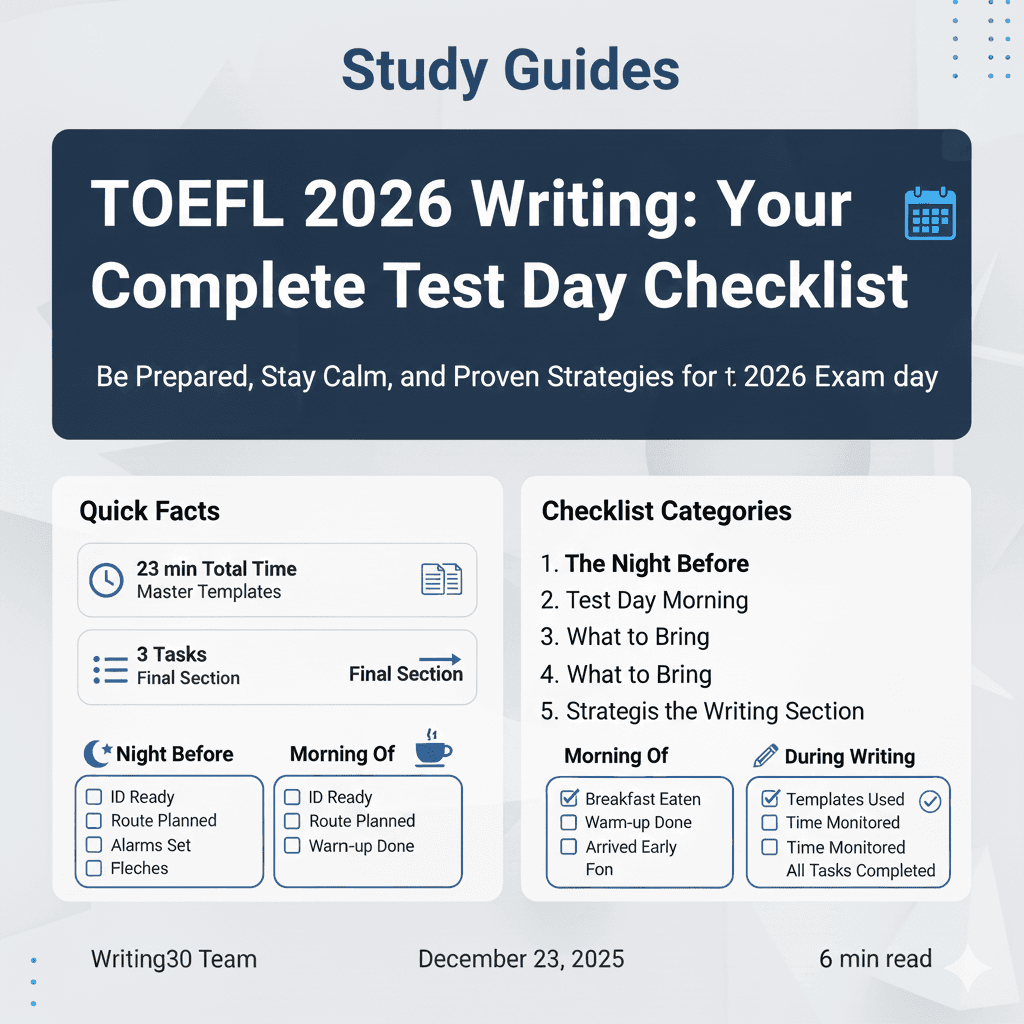
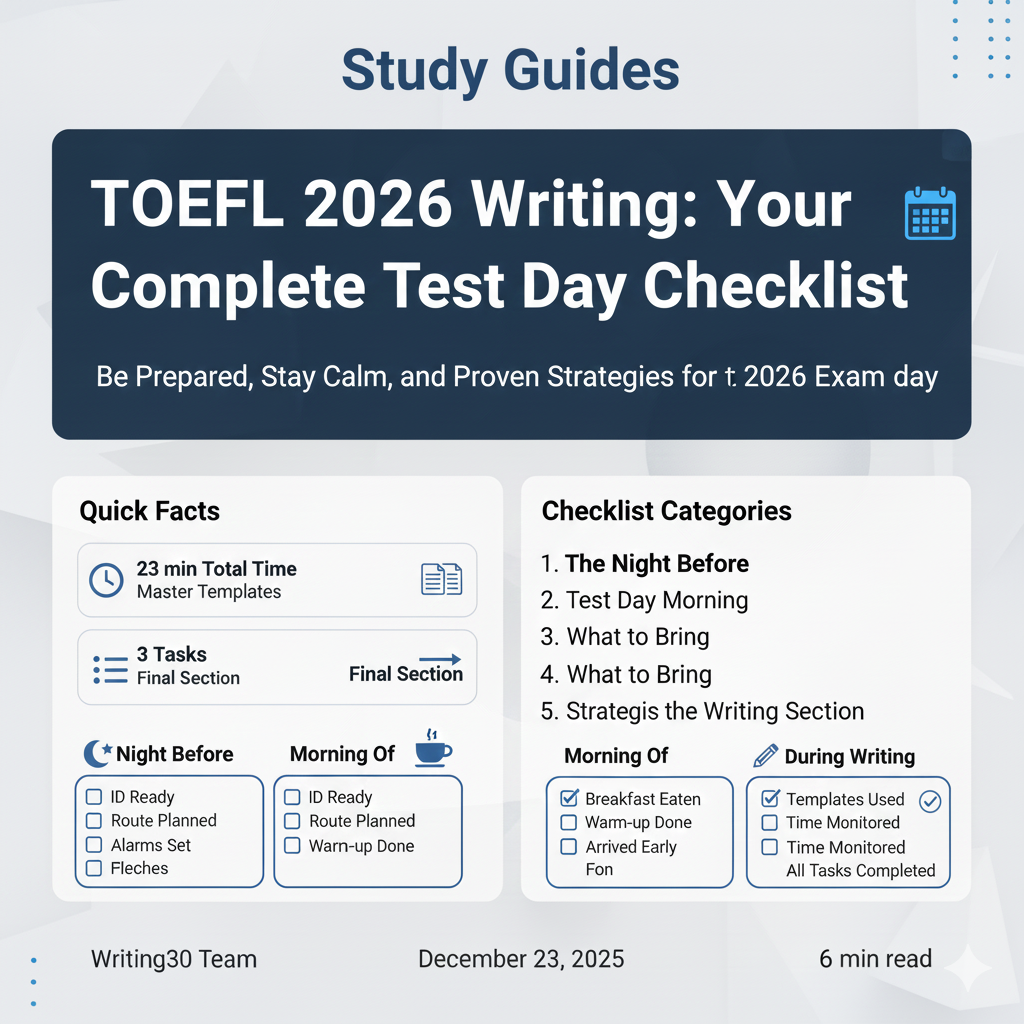
Visual Summary: Test Day Checklist at a Glance
Save or print this infographic for quick reference before your test. It summarizes everything you need to prepare the night before, on test day morning, and during the writing section.
References & Further Reading
- TOEFL iBT Test Day Tips — ETS Official Website (Accessed: December 2025)
- TOEFL iBT Test Center Requirements — ETS Official Website (Accessed: December 2025)
- TOEFL iBT Test Content and Structure — ETS Official Website (Accessed: December 2025)
- What to Expect on TOEFL Test Day — ETS TOEFL Preparation (Accessed: December 2025)
- TOEFL iBT Writing Section Updates 2026 — ETS TOEFL Preparation (Accessed: December 2025)
External links open in a new tab. Writing30 is not affiliated with the linked sources.
Tags
Ready to Improve Your TOEFL Writing?
Get instant AI-powered feedback on your TOEFL writing. Practice with real prompts and see your score improve.
Try Writing30 AI