
When Is It Appropriate to Use a Semicolon in TOEFL Writing
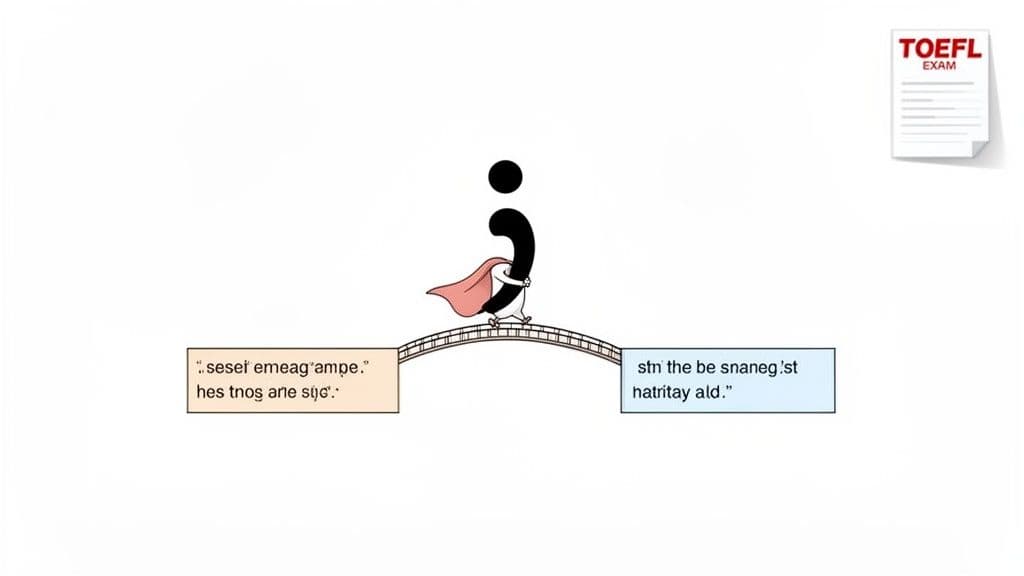
Feeling the pressure of the TOEFL writing section? You're not alone. Many students get anxious about complex grammar, but what if one simple punctuation mark could be the key to unlocking a higher score?
The semicolon might seem intimidating, but it’s actually your secret weapon for the 2026 TOEFL format. When you know when is it appropriate to use a semicolon, you’re not just following a grammar rule—you’re showing the ETS graders that you have advanced control over your writing, a key factor for a high score.
Your Secret Weapon for a Higher TOEFL Writing Score

Think of the semicolon not as a source of anxiety, but as a strategic tool for sophistication. When a grader sees a correctly placed semicolon, it immediately signals a high level of writing proficiency. It proves you can build complex sentences and organize ideas with precision—both are key criteria in the official TOEFL scoring rubric for language use and topic development.
Using a semicolon correctly makes your writing clearer and more impressive. It’s a small detail that can have a big impact on how your responses are perceived, helping you score in the higher bands.
This guide will show you exactly how this punctuation can elevate your writing in all three TOEFL writing tasks effective January 21, 2026.
- Build a Sentence: This task is all about combining ideas logically. A semicolon allows you to fuse two complete thoughts into a single, grammatically powerful sentence, demonstrating a deep understanding of sentence structure.
- Write an Email: In your email responses, using a semicolon to link related points makes your communication more professional and fluid. It’s a sophisticated way to connect ideas without overusing simple words like "and" or "but."
- Academic Discussion: When you need to list complex points or synthesize information, a semicolon helps organize your post for maximum clarity. This directly impacts your score for organization and development.
By learning to use the semicolon effectively, you’re not just avoiding errors; you're actively adding a layer of polish that can push you into a higher score band.
For a quick reference, here's a breakdown of how the semicolon helps you on test day.
Semicolon Use for a Top TOEFL Score
| When to Use a Semicolon | Why It Boosts Your Score | Example for TOEFL Tasks |
|---|---|---|
| Connecting two related complete sentences. | Shows you can create complex sentences without run-ons or comma splices, a high-level skill under the 'Language Use' rubric criterion. | "The professor's argument is compelling; however, it overlooks several key factors." (Academic Discussion) |
| Separating items in a complex list. | Demonstrates advanced organizational skills, especially when listing items that contain commas. This improves clarity for the 'Topic Development' score. | "The study involved teams from Paris, France; Tokyo, Japan; and Lima, Peru." (Academic Discussion or Email) |
Mastering these two uses is all you need to make your TOEFL writing stand out.
Ready to see how it works? We’ll start with the most common use: connecting two related ideas. And if you're looking for more ways to level up your writing, check out our complete guide on how to improve your TOEFL writing score.
Connecting Related Ideas Like a Pro
Think of the semicolon as a special kind of period. Its main job is to connect two complete sentences that are too closely related to be separated by a full stop. This creates a stronger, more sophisticated link than just using "and" or starting a new sentence.
Mastering this shows TOEFL graders you have an advanced command of English sentence structure. Knowing when is it appropriate to use a semicolon to link complete thoughts is a clear signal of a high-level writer aiming for a top score.
What Is a Complete Thought?
A complete thought is what grammar experts call an independent clause. It's simply a group of words that could stand on its own as a full sentence. It has a subject and a verb, and it makes complete sense.
For example, here are two independent clauses:
- The campus library is open 24 hours.
- It provides a quiet space for students to prepare for exams.
Since these two ideas are directly connected, you can join them with a semicolon. This is exactly the kind of move that impresses graders.
TOEFL Example: "The campus library is open 24 hours; it provides a quiet space for students to prepare for exams."
This one, fluid sentence is far more advanced than two short, choppy sentences. It's a small tweak that demonstrates high-level writing skill.
Avoiding the Dreaded Comma Splice
A very common mistake is using a comma where a semicolon is needed. This error is called a comma splice, and it can seriously hurt your score on the 'Language Use' criterion of the rubric.
For example, imagine you write this in the "Write an Email" task: "I appreciate your invitation, however, I must decline due to prior commitments." This is a comma splice.
Fixing it is easy. Just swap the comma for a semicolon: "I appreciate your invitation; however, I must decline due to prior commitments." This instantly corrects the error and makes your writing look much more polished.
Spotting Semicolon Opportunities in TOEFL Tasks
This is a skill you can use across all three 2026 writing tasks.
Build a Sentence: This task is a direct test of your ability to combine phrases correctly. If you spot two complete thoughts among the scrambled words, a semicolon might be the most effective connector.
- Actionable Tip: When practicing, look for two subject-verb pairs. If you find them, see if a semicolon can join them logically.
Academic Discussion: When you respond to the professor, you might make a point and then immediately add a related explanation. A semicolon is perfect for this.
- Sample Response: "The author's main argument is that renewable energy is cost-effective; this completely changes the economic debate."
Write an Email: In professional writing, semicolons help you sound clear and efficient. You can connect two related points smoothly.
- Sample Response: "Our team has completed the initial research; the final report will be ready by Friday."
Start looking for places where two of your sentences share a close, logical connection. Could they be joined with a semicolon? Try it out. The instant feedback tools at writing30.com can help you practice this until it becomes second nature, turning a tricky punctuation mark into easy points on test day.
Organizing Complex Lists for Maximum Clarity
In the Academic Discussion task, you have to pull together different pieces of information into one coherent response. This is where the semicolon really shines, especially when you're dealing with complex lists.
Think about it: if the items in your list already have commas inside them (like city, state), adding more commas just to separate the items creates a mess. The semicolon acts like a "super-comma"—a stronger pause that creates clear divisions and helps your reader (and the ETS grader) navigate your ideas without getting lost.

Using this punctuation mark is a clear sign of sophisticated academic writing. It directly hits the ETS rubric's marks for organization and accuracy, which is exactly what you need to push your score into a higher band.
Mastering the "Super-Comma" for TOEFL Success
Using semicolons correctly in lists shows graders you can handle complex sentences with confidence. It eliminates confusion and makes your argument easy to follow—a critical skill for scoring high on 'Topic Development.'
Let's break down a common scenario. Imagine an Academic Discussion prompt asks you to summarize the backgrounds of several researchers mentioned in the lecture.
- Without Semicolons (Confusing): The team included Sarah Chen, the lead researcher from Toronto, Canada, Ben Carter, the data analyst from Austin, Texas, and Maria Flores, the project manager from Lima, Peru.
This sentence is confusing. You can’t easily tell where one person's information ends and the next begins.
- With Semicolons (Clear and Impressive): The team included Sarah Chen, the lead researcher from Toronto, Canada; Ben Carter, the data analyst from Austin, Texas; and Maria Flores, the project manager from Lima, Peru.
See the difference? The semicolons function as powerful dividers, making the list organized and instantly readable. This is a high-level skill that will make your writing stand out.
Key Takeaway for TOEFL: When your list items already contain commas, use semicolons to separate them. This proves you have advanced grammatical control and improves the clarity of your response, boosting your score for both
Language UseandTopic Development.
Applying Semicolons in the Academic Discussion
For the Academic Discussion task, you must synthesize ideas and present them logically. This is a game-changer for scoring well.
Imagine a prompt asks you to "Discuss the benefits of urban green spaces based on the lecture."
- Sample Response: "The professor highlighted several benefits of urban green spaces, such as improving public health in densely populated areas like New York City, USA; supporting biodiversity in established parks in London, England; and boosting local economies through tourism in cities like Paris, France."
Without the semicolons, that sentence would just be a jumble of cities and countries. By using them, you present a well-structured, easy-to-digest argument. This small change prevents your score from dropping due to a confusing structure.
Actionable Tip: The next time you finish an Academic Discussion prompt on writing30.com, go back and review your response. Scan for any lists you made. Do the items in your list have their own commas? If they do, edit the sentence to use semicolons as separators. This simple check will help you build a powerful writing habit for test day.
Using Transitional Words for Smoother Arguments
This is a high-level move that signals serious grammatical skill to TOEFL graders: pairing a semicolon with a transitional word. It's the perfect technique for adding analytical depth to your writing, especially in the Academic Discussion task.
The rule is consistent and easy to master. When you connect two complete sentences with a transitional word (also called a conjunctive adverb) like however, therefore, or consequently, the punctuation is always the same: semicolon before the word, comma after.

This structure builds a strong, logical bridge between your ideas. It shows graders you can control complex sentences, a key marker for anyone aiming for a score in the high-intermediate to advanced range.
Building Stronger Arguments in TOEFL Tasks
Let’s see how this works in a real task. The Academic Discussion post often requires you to contrast different points of view or show a cause-and-effect relationship. Using a semicolon with a transitional word is the most professional way to do this.
Imagine you're writing an Academic Discussion response:
Sample Response: The professor makes a valid point about the cost of renewable energy; however, recent studies indicate that solar panel prices are decreasing rapidly.
This isn't just two separate facts. The use of ; however, creates a direct, thoughtful contrast. It proves you're not just listing ideas but actively analyzing how they relate—far more powerful than just using "but" or starting a new sentence.
This move also works wonders in the "Write an Email" task. You might need to deliver news or make a polite but firm suggestion.
- Sample Email Response: "The project deadline is approaching quickly; therefore, I suggest we schedule a brief meeting to align on the final steps."
The structure is direct, polished, and professional. It demonstrates you understand when is it appropriate to use a semicolon to build a logical argument, taking your response from average to advanced.
A List of Useful Transitional Words
To get started, here are some of the most common transitional words to use with semicolons. Don't try to memorize the whole list. Instead, pick a few that feel natural for you and practice them.
- To Show Contrast: however, nevertheless, nonetheless, on the other hand
- To Show a Result: therefore, consequently, accordingly, as a result, thus
- To Add an Idea: moreover, furthermore, additionally, in addition
- To Give an Example: for example, for instance
Actionable Tip: Choose one word from each category (e.g., 'however', 'therefore', 'moreover') and aim to use it once in your next practice essay. The AI-powered tools at writing30.com give you instant feedback on sentence structure and can even suggest where to add these transitions to make your arguments flow better. A little practice goes a long way.
Common Semicolon Mistakes to Avoid on Test Day
Knowing the rules is half the battle; avoiding the common traps is the other half. When you're under pressure on test day, it’s easy to make small punctuation mistakes that can drag down your 'Language Use' score. Let’s make sure you don't fall for them.
Understanding when to use a semicolon also means knowing when not to. Avoiding these simple mistakes shows the TOEFL graders you have true mastery of English punctuation.
Mistake 1: Using a Semicolon Before a List
This is a very common error. A semicolon's job is not to introduce a list—that’s what a colon is for. Using a semicolon here immediately signals that you're not quite sure about the rules.
- Incorrect: The professor discussed several key topics; the industrial revolution, modern art, and quantum physics.
- Correct: The professor discussed several key topics: the industrial revolution, modern art, and quantum physics.
Just remember this simple rule: if you’re about to list items, use a colon (:). The only time you'll see a semicolon in a list is when the list items themselves are complex and already contain commas.
Mistake 2: Connecting an Incomplete Thought
A semicolon needs a complete, standalone sentence on both sides. Its real power comes from balancing two equal, independent ideas. If you connect a full sentence to an incomplete phrase (a dependent clause), you’ve just created a critical error.
TOEFL Example - Before & After Incorrect: The university is known for its engineering program; a top-ranked department with excellent faculty.
Correct: The university is known for its engineering program; it is a top-ranked department with excellent faculty.
See the fix? We turned "a top-ranked department..." into a full sentence by adding "it is." Before you use a semicolon, always double-check: can both sides stand alone as their own sentences? If you're struggling to avoid these pitfalls, our guide on common grammar mistakes provides more examples and fixes.
Mistake 3: The Semicolon and "FANBOYS" Overlap
This is another trap. You should never use a semicolon and a simple coordinating conjunction (For, And, Nor, But, Or, Yet, So—think FANBOYS) together to join two sentences. You have to pick one or the other.
- Incorrect: The study had a small sample size; but its findings were significant.
- Correct (Option 1): The study had a small sample size, but its findings were significant.
- Correct (Option 2): The study had a small sample size; its findings were significant.
Both of the corrected versions are perfectly grammatical, but they give the sentence a slightly different feel. The semicolon creates a stronger, more direct link between the two ideas. By mastering these "do nots," you're not just protecting your score—you're building the confidence to use punctuation perfectly when it counts.
Frequently Asked Questions About Semicolon Use
Let's tackle some of the most common sticking points with semicolons. These are the quick-fire questions students ask all the time, and getting the answers straight will help you use semicolons with confidence on test day.
Should I Use a Capital Letter After a Semicolon?
Almost never. Think of a semicolon as a "soft stop" that connects two closely related parts of the same sentence. Since the word that follows isn't starting a new sentence, it should be lowercase.
The only time you'd use a capital is if the word is a proper noun, like a name or a city (e.g., "I have one goal; London is the destination.").
What Is the Difference Between a Semicolon and a Colon?
This is a big one. A semicolon connects two complete, independent sentences that could stand on their own. In contrast, a colon (:) is used to introduce something—like a list, a quote, or an explanation that follows a complete sentence.
Here's a simple test: Can both clauses stand alone as full sentences? If yes, a semicolon is a good choice. If the second part explains or lists something from the first part, you likely need a colon.
How Many Semicolons Should I Use in My TOEFL Writing?
Focus on quality, not quantity. On the TOEFL, one or two perfectly placed semicolons are far more impressive than five or six used incorrectly. A good goal is to aim for one correct use in your Academic Discussion post and, if appropriate, one in your email.
Overusing them can make your writing feel clunky. Use them only when they are the ideal tool to show a sophisticated connection between your ideas.
Stop guessing and start improving. Get instant, rubric-aligned feedback on your TOEFL writing with Writing30 and see your estimated score in seconds. Try our free practice tools at writing30.com today.
Ready to Practice?
Try all 3 TOEFL 2026 writing tasks with instant AI feedback.
Tags
Ready to Improve Your TOEFL Writing?
Get instant AI-powered feedback on your TOEFL writing. Practice with real prompts and see your score improve.
Try Writing30 AI