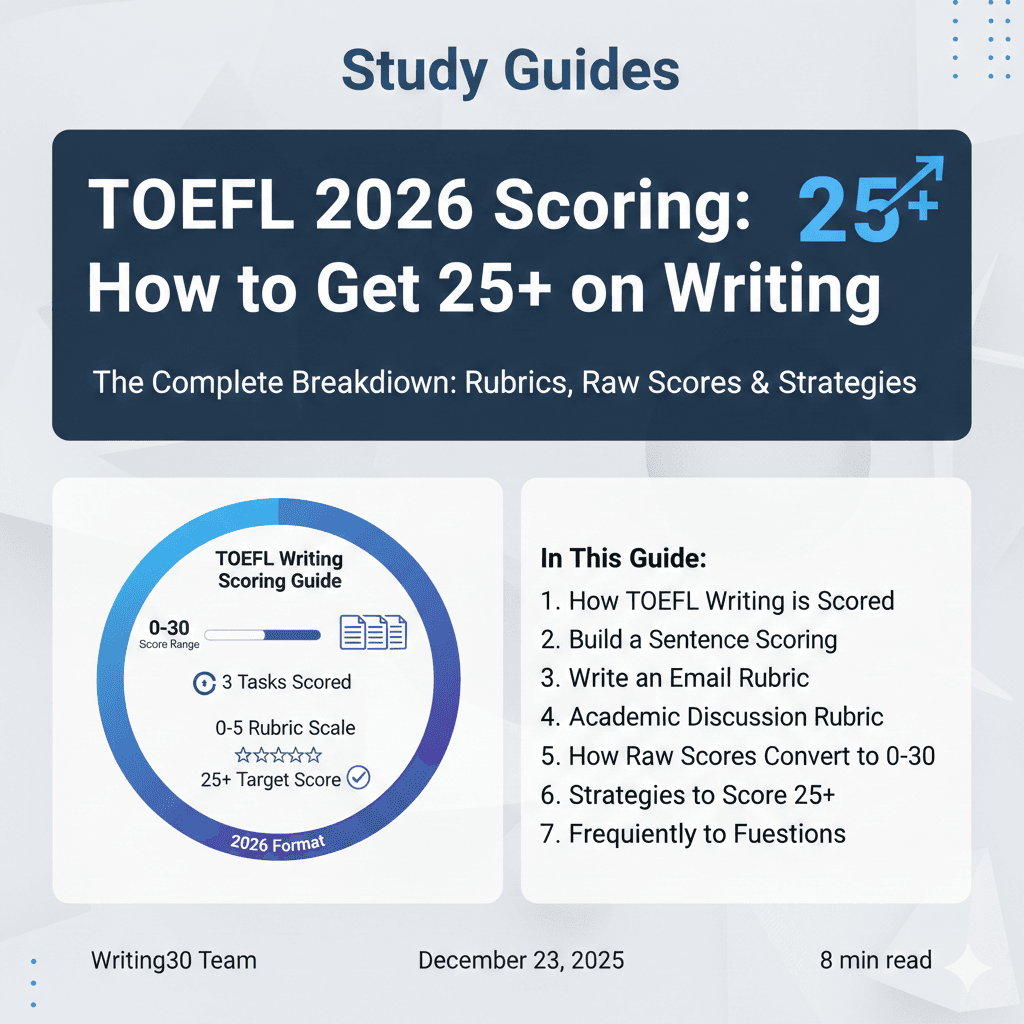
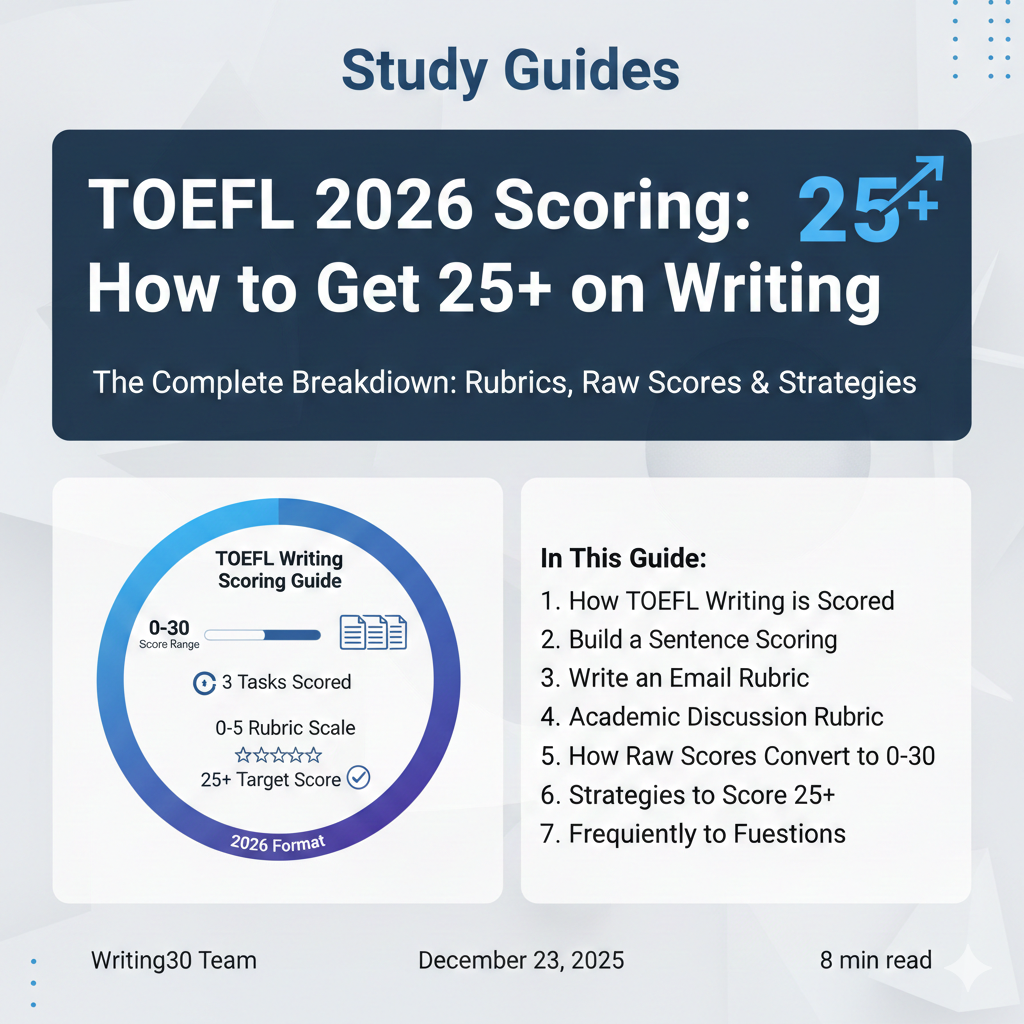
TOEFL 2026 Scoring: How to Get 25+ on Writing
Quick Answer
Since January 21, 2026, the TOEFL writing section is reported as a band from 1.0 to 6.0 in half-point increments. Each of the three tasks (Build a Sentence, Write an Email, Academic Discussion) is scored individually, then combined into that single band. The familiar 0-30 writing scale is the prior format — most university requirements are still published on it (typically 22-25, with top programs expecting 25-28+), and the old average was approximately 21 out of 30, so this guide covers both scales.
Key Takeaways
- ✓Score reports now show a 1.0-6.0 writing band (half-point steps); the 0-30 score is the prior scale, kept here for comparison
- ✓Build a Sentence is scored correct/incorrect; Email and Discussion use a 0-5 rubric
- ✓Average TOEFL writing score was approximately 21 out of 30 on the prior scale
- ✓Most universities still state requirements on the prior 0-30 scale: typically 22-25, top programs 25-28+
- ✓Scores are determined by both human raters and ETS's e-rater AI system
- ✓The 2026 format replaced the old Integrated and Independent Writing tasks
Watch: TOEFL Writing Scoring Explained
Tips and tricks for maximizing your TOEFL writing score
How is TOEFL Writing Scored in 2026?
The TOEFL 2026 writing section uses two different scoring methods depending on the task type[1], and since January 21, 2026 the combined result is reported as a 1.0-6.0 band in half-point increments[7] — the 0-30 writing score you see quoted across the web is the prior scale, still used to compare against older university requirements. Understanding both is crucial for maximizing your score.
Scoring Methods by Task
Build a Sentence (4-6 items)
Binary scoring: Correct (1) or Incorrect (0). No partial credit.
Write an Email (1 task)
Rubric scoring: 0-5 scale evaluating content, format, tone, and grammar.
Academic Discussion (1 task)
Rubric scoring: 0-5 scale evaluating position, reasoning, engagement, and grammar.
Human + AI Scoring
TOEFL uses a combination of human raters and e-rater (AI) for scoring[3]. Build a Sentence is scored automatically. Email and Discussion tasks receive both human and AI scores, which are combined for final evaluation.
Build a Sentence Scoring
The Build a Sentence task uses dichotomous scoring—each item is either completely correct or incorrect[4]. There's no partial credit for "almost right" answers.
What Makes an Answer Correct?
- Grammatically accurate: Correct subject-verb agreement, word order, modifiers
- Semantically appropriate: The sentence logically answers the context question
- Complete sentence: All required words used in proper positions
| Performance | Items Correct | Impact on Score |
|---|---|---|
| Excellent | 6/6 or 5/6 | Maximum contribution to your section band |
| Good | 4/6 | Strong contribution |
| Fair | 3/6 | Moderate contribution |
| Poor | 0-2/6 | Minimal contribution, hurts overall score |
For strategies on mastering this task, see our Build a Sentence complete guide.
See how your writing scores
Submit any of the 3 TOEFL 2026 tasks and get instant AI scoring aligned to the ETS rubric.
Write an Email Scoring Rubric
The Write an Email task is scored on a 0-5 rubric evaluating four key dimensions[6]. Here's what each score level requires:
- • All three communicative goals accomplished with specific detail
- • Professional register and tone consistently maintained
- • Clear, logical organization with smooth flow
- • Consistent grammatical accuracy; minor errors only
- • Rich, relevant content at a full length (80-120 words is a good practice target)
- • All three goals accomplished with adequate detail
- • Generally appropriate professional register
- • Clear organization; mostly logical flow
- • Generally accurate grammar; occasional errors don't impede meaning
- • All goals addressed but with limited development
- • Register somewhat appropriate; tone inconsistent
- • Adequate organization but may lack clarity
- • Some grammatical errors that occasionally impede meaning
- • Some goals addressed or inadequately developed
- • Register/tone often inappropriate
- • Poor organization; ideas don't flow logically
- • Frequent errors that sometimes impede meaning
- • Goals minimally addressed or missing
- • Register/tone inappropriate throughout
- • Disorganized; difficult to follow
- • Numerous errors that frequently impede understanding
Official Rubric: For the complete official ETS Write an Email scoring rubric with detailed criteria for each score level, see our Write an Email guide - Official Scoring Rubric section.
Academic Discussion Scoring Rubric
The Academic Discussion task is also scored on a 0-5 rubric, but with emphasis on peer engagement and argumentation[6]:
| Score | Position & Support | Peer Engagement | Grammar |
|---|---|---|---|
| 5 | Clear position with strong, well-developed support | Thoughtful engagement with both peers | Consistent control; sophisticated |
| 4 | Clear position with adequate support | Meaningful engagement with at least one peer | Generally accurate; good variety |
| 3 | Position stated with basic support | Some engagement, may be superficial | Adequate; some errors |
| 2 | Position inadequately supported | Minimal or forced engagement | Frequent errors |
| 1 | Position unclear or absent | Little or no engagement | Numerous errors |
Key Insight: Peer Engagement is Critical
Responses that don't reference the other students' points typically score 3 or below, even with excellent grammar. Always mention at least one peer by name.
Official Rubric: For the complete official ETS Academic Discussion scoring rubric with detailed criteria for each score level, see our Academic Discussion guide - Official Scoring Rubric section.
Understanding TOEFL Scoring: Task Scores, the 1-6 Band & the Prior 0-30 Scale
TOEFL writing scoring has three tiers you will encounter[2]: the 0-5 task rubric, the 1.0-6.0 section band that has appeared on score reports since January 21, 2026[7], and the prior 0-30 scale that most university requirements still quote. Understanding how these tiers connect helps you set realistic targets and know exactly what performance level you need to achieve your goal score.
The 3-Tier Scoring System
Tier 1: Task Scores (0-5)
Each task is scored individually. Build a Sentence items are converted to a 0-5 equivalent based on items correct. Write an Email and Academic Discussion are scored directly on the 0-5 rubric.
Tier 2: Section Band (1-6) — Your Reported Score
Your task scores are averaged, then converted to a section band on a 1-6 scale in half-point increments. Since January 21, 2026, this band is what appears on your score report — it is the score universities see.
Tier 3: Prior 0-30 Scale (Comparison Only)
Before January 21, 2026, the section result was converted to a 0-30 scaled score for reporting. That scale is retired from score reports, but most university requirements and prep tools (including Writing30's /30 estimates) still quote it, so we show clearly labeled 0-30 comparisons throughout this guide.
Key Formula
Section Score ≈ Task Average + 1 point. For example, if your task average is 4.0, your section score will typically be around 5. This relationship helps you estimate what task-level performance you need.
Score Conversion Examples
| Build a Sentence | Write an Email | Academic Discussion | Task Average (0-5) | Section Score (1-6) |
|---|---|---|---|---|
| 10 (5.0) | 4.5 | 4 | 4.5 | 5.5 |
| 10 (5.0) | 2 | 4 | 3.7 | 4.5 |
| 10 (5.0) | 3 | 4 | 4.0 | 5 |
| 8 (4.0) | 3.5 | 3.5 | 3.7 | 4.5 |
Strategic Insight
So if you need a 4.5 section score, aim for a task average around 3.5-4. Strong performance on one or two tasks can compensate for a weaker one. Focus your preparation on tasks where you can make the biggest improvements.
Try the Interactive Calculator
Enter your scores below to see your estimated task average, section band, and the equivalent on the prior 0-30 comparison scale in real-time:
TOEFL Writing Score Calculator
Enter your scores to estimate your TOEFL Writing section result
Number of correct answers (0-10)
Rubric score (0-5, decimals allowed)
Rubric score (0-5, decimals allowed)
Your Estimated Score
Writing30 estimate (pre-2026 0-30 comparison scale)
Task Average (0-5)
Estimated 1-6 band (Writing30 estimate)
Minimal ability to express ideas in written English
How This Calculator Estimates Your Score (Writing30 method)
What ETS publishes: the 0-5 scoring rubrics for Write an Email and Academic Discussion, and that since January 21, 2026 official score reports show a 1-6 section band in half-point increments. What ETS does not publish: any formula for combining the three task scores into a section band. Every combined number below is Writing30's own estimate, not an official calculation.
Step 1 — Individual Task Scoring: Each of the three writing tasks is scored independently. Build a Sentence answers are correct/incorrect, while Write an Email and Academic Discussion use the official 0-5 rubrics.
Step 2 — Normalization (Writing30): This calculator normalizes all task scores to a common 0-5 scale. Build a Sentence scores are converted proportionally (e.g., 7/10 = 3.5/5).
Step 3 — Task Average (Writing30): The three normalized scores are averaged to produce a task average (0-5).
Step 4 — Estimated Band (Writing30): The task average is mapped to an estimated 1-6 band using Writing30's heuristic (1 + task average, rounded to the nearest 0.5) — a simplification, not an ETS formula.
Step 5 — Pre-2026 Comparison (Writing30): The estimated band is converted to the retired 0-30 scale with Writing30's comparison table, so you can relate the result to older score requirements. Official 2026 reports never show a 0-30 writing score.
Note: Actual ETS scoring includes human/AI rating and statistical adjustments ETS does not disclose. Treat every number here as a practice estimate — official scores come only from ETS.
6 Strategies to Score 25+ on TOEFL Writing

Understanding the scoring rubric is key to achieving a high TOEFL writing score
Perfect your Build a Sentence
Aim for 5-6/6 correct. Practice word order patterns daily. This task is binary—no room for error.
Follow the rubric criteria
Structure your Email and Discussion responses to address every rubric dimension: content, organization, tone, grammar.
Always engage with peers
In Academic Discussion, mention at least one student by name. This is a key scoring criterion often missed.
Use appropriate register
Professional tone for emails (Dear..., Sincerely). Academic tone for discussions. No slang or casual language.
Hit the word-count practice targets
Email: 80-120 words. Discussion: 100-150 words. These are practice targets, not ETS rules — but too short usually means insufficient development and a lower score.
Proofread key sentences
Grammar errors in your opening and closing sentences hurt disproportionately. Check these carefully.
Review our 10 grammar mistakes guide to avoid common errors that cost points.
Frequently Asked Questions
How is TOEFL writing scored in 2026?
TOEFL 2026 writing uses two scoring methods: Build a Sentence items are scored correct or incorrect (binary). Write an Email and Academic Discussion tasks use a 0-5 rubric evaluating content, organization, tone/register, and grammar. Since January 21, 2026, the combined result is reported as a section band from 1.0 to 6.0 in half-point increments — the prior 0-30 scaled score now serves only as a comparison with older published requirements.
Is TOEFL writing scored by humans or computers?
Both. Build a Sentence is scored automatically. Email and Discussion tasks are evaluated by human raters and ETS's e-rater AI system, with scores combined for reliability.
What score do I need for universities?
Most universities still publish writing requirements on the prior 0-30 scale: typically 22-25+, with top programs at 25-28+. Check your target school's specific requirements, as they vary.
Can I see my individual task scores?
Your score report shows your overall writing band (1.0-6.0, in half-point increments); the 0-30 section score is the previous reporting format. Individual task scores are not typically provided, though score descriptors indicate your performance level.
What's the difference between section score (1-6) and the 0-30 scale?
Individual tasks are scored on a 0-5 scale. These three scores are averaged to get your task average, which converts to a section band of 1-6, reported in half-point increments. Since January 21, 2026, that band is what appears on your score report. The 0-30 scale is the prior reporting format: a section band of 4.5 roughly equals 22-24 on the old scale, which is still useful for comparing against requirements published before the change.
TOEFL Writing Scores: Common Questions
What is a good TOEFL writing score?
A good TOEFL writing score depends on your goals. On the prior 0-30 scale that most universities still quote in requirements: 17-23 is intermediate, 24-27 is good, and 28-30 is excellent. Most universities require 22-25 for admission, while top programs like Harvard or MIT may require 27+. According to ETS data from the 0-30 era, the average writing score was approximately 21. Current score reports show writing as a 1.0-6.0 band.
What is a TOEFL score of 30?
A writing score of 30 was a perfect score on the prior 0-30 scale — the highest possible before ETS moved to band reporting on January 21, 2026. On current score reports the maximum is a 6.0 band, with every section reported from 1.0 to 6.0 in half-point increments. Only about 1% of test-takers achieved a perfect 30 on writing in the 0-30 era.
What is the TOEFL writing score scale?
Since January 21, 2026, TOEFL writing is reported as a band from 1.0 to 6.0 in half-point increments, alongside an overall 1-6 band for the whole test. Individual tasks (Build a Sentence, Write an Email, Academic Discussion) are still scored on a 0-5 rubric and combined into that band. The 0-30 scale is the prior format: its ETS levels — Advanced (24-30), High-Intermediate (17-23), Low-Intermediate (13-16), Below Low-Intermediate (0-12) — still appear in many university requirements, so 0-30 comparisons remain useful.
What is a passing TOEFL score?
There is no universal "passing" TOEFL score — requirements vary by institution. Most requirements are still published on the prior scales: 80+ total (0-120) with 20+ on writing is a common minimum, and competitive programs typically ask for 100+ total with 25+ on writing. During the transition ETS provides a comparable 0-120 overall score alongside the new 1-6 bands, so you can still measure yourself against those thresholds. Always check your target school's specific TOEFL requirements.
Are TOEFL unofficial scores out of 30?
Not anymore. Since January 21, 2026, every TOEFL section is reported as a 1.0-6.0 band, so unofficial results follow that format too — 0-30 was the prior scale. You can view unofficial Reading and Listening results right after the test; Writing takes longer because it requires human and AI evaluation.
Is 94 a bad TOEFL score?
A total score of 94 refers to the prior 0-120 scale, which ETS still provides as a comparison score during the transition to 1-6 band reporting. It is not bad — it sits above that scale's global average of approximately 87 and meets requirements at many universities, though highly competitive programs often ask for 100+. Focus on improving your weakest section for the biggest score gains.
Which TOEFL score is B2?
On the prior 0-120 total scale, 72-94 corresponds to CEFR level B2 (Upper Intermediate) according to ETS's score comparison from that era, and 95+ maps to C1 (Advanced). For writing on the prior 0-30 scale, 17-23 aligns with B2 and 24-30 with C1. For the 1-6 bands used on current score reports, check ETS's understanding-scores page for the official CEFR alignment.
What is a good TOEFL score out of 30?
On the prior 0-30 writing scale — the one most published requirements still reference — 24-27 is a good score for most university programs, 28-30 is excellent and competitive for top schools, and 20-23 is adequate for less competitive programs. Aim for the equivalent of at least 25 if applying to ranked universities. Current score reports express writing as a 1.0-6.0 band.
Visual Summary: TOEFL Writing Scoring at a Glance
Save or bookmark this infographic for quick reference. It summarizes how your TOEFL writing score is calculated, the scoring criteria, and tips for achieving 25+.
Scoring Guides for Other Sections
References & Further Reading
- TOEFL iBT Test Scores and Score Reports — ETS Official Website (Accessed: December 2025)
- Understanding TOEFL iBT Scores — ETS Score Users Guide (Accessed: December 2025)
- TOEFL iBT Writing Section Scoring Rubrics — ETS TOEFL Preparation (Accessed: December 2025)
- TOEFL iBT Test Content and Structure — ETS Official Website (Accessed: December 2025)
- TOEFL iBT Score Requirements for Universities — ETS Institutions Guide (Accessed: December 2025)
- TOEFL iBT Writing Section Rubrics — ETS Official Writing Rubrics (Accessed: January 2026)
- Understanding TOEFL iBT Scores — ETS Score Understanding Guide (Accessed: January 2026)
External links open in a new tab. Writing30 is not affiliated with the linked sources.
Tags
Ready to Improve Your TOEFL Writing?
Get instant AI-powered feedback on your TOEFL writing. Practice with real prompts and see your score improve.
Try Writing30 AI