8 TOEFL Problem-Solving Examples for a High Writing Score
Visual digest
Read less randomly. Practice more deliberately.
Use the quick answer first, then move into examples and one practice step before reading another article.
Task demand
Rubric behavior
Practice response
Stop after this article with one written note: the rule, the mistake to avoid, and the next practice attempt.
Tackling the TOEFL writing section, especially the 2026 format, can feel like solving a puzzle. Don't worry, you've got this! This article provides a detailed look at problem solving essay examples designed specifically to help you master the new tasks. Instead of just showing you finished essays, we break down common problems TOEFL students face and offer clear, actionable solutions. Each section serves as a mini-lesson, targeting issues that can hold you back, from weak grammar to test-day anxiety.
You will see exactly how to approach each of the three writing tasks: Build a Sentence, Write an Email, and Academic Discussion. We'll pinpoint common mistakes and then provide practical revision tips you can apply immediately in your practice. This approach moves beyond theory, giving you a supportive framework for identifying problems and implementing effective solutions in your own writing.
Our goal is to demystify what makes a high-scoring response (25-30 range). We'll explore strategies for structuring your arguments, expanding your word choice, and managing your time effectively under exam pressure. By dissecting these problem solving essay examples, you'll learn to build stronger, more persuasive arguments for the Academic Discussion task and improve your clarity for the Email and Build a Sentence tasks. Let’s get started by examining the first common problem: low writing scores.
1. Academic Writing: Addressing Low TOEFL Writing Scores Through Structured Practice
Low scores on the TOEFL writing section often stem from a clear problem: unstructured practice and a lack of specific, timely feedback. Many test-takers practice by writing full essays and hoping for improvement, but they struggle to identify the exact reasons behind their score plateaus. This problem-solving approach directly targets that gap by proposing a highly structured solution: using a dedicated practice platform to receive instant, rubric-aligned feedback.
This method transforms practice from a guessing game into a targeted training regimen. Instead of vague uncertainty, you get concrete data on your performance across key scoring criteria like grammar, vocabulary, coherence, and task fulfillment. This is one of the most effective problem solving essay examples in a real-world academic context because the solution is directly tied to diagnosing and fixing the underlying issues.
How It Works: A Step-by-Step Solution
The core of this solution involves breaking down the TOEFL writing test into manageable parts and using technology to accelerate the feedback loop. Platforms like Writing30 are built for this purpose, offering specific modules for the 2026 TOEFL format.
Problem: Weak sentence construction and grammatical errors.
Solution: Begin with Build a Sentence tasks. These drills sharpen your ability to form complex, grammatically correct sentences under pressure, a foundational skill for all writing tasks.
Problem: Difficulty with tone, organization, and conciseness in shorter formats.
Solution: Progress to Write an Email tasks. These simulate a common real-world academic scenario and help you master clear, purposeful communication before tackling the more complex Academic Discussion.
Strategic Insight: By isolating skills, you can fix foundational weaknesses without the cognitive load of writing a full essay. An ESL learner who used this method completed over 40 practice submissions on Writing30, systematically eliminating comma splices and improving verb tense, which raised their score from 18 to 27.
Actionable Tips for Implementation
To make this solution work for you, adopt a consistent routine. It's all about practice!
- Review Feedback Weekly: Don't just complete tasks; analyze the feedback. Look for patterns in your mistakes. Are you consistently misusing articles or struggling with transition words?
- Use Provided Resources: Take advantage of templates and suggested linking words. These are not cheats; they are scaffolds that help you internalize strong structural patterns for a high-scoring response.
- Set a Practice Quota: Aim for at least 3-4 practice sessions per week. A working professional improved their coherence score significantly by completing 15 email tasks over three weeks, focusing solely on the platform's feedback for organization. This consistent effort builds muscle memory and confidence for test day.
2. Time Management Crisis: Building Speed and Accuracy Under Timed Exam Conditions
A common crisis for TOEFL test-takers is running out of time, which leads to rushed, incomplete answers and costly errors. The core problem isn't just slow writing; it's the lack of a strategy to manage speed and accuracy simultaneously under pressure. This problem-solving approach addresses the issue by proposing a system of timed practice with mock exams and time-tracking tools, turning panicked writing into a controlled, efficient process.
This method makes practice deliberate. Instead of just trying to "write faster," you diagnose the specific bottleneck: are you spending too much time planning, typing, or editing? This is a powerful real-world application of problem solving essay examples because it provides a clear, measurable solution to the universal test-day challenge of a ticking clock. By simulating exam conditions, you build the muscle memory needed to perform well when it counts.
How It Works: A Step-by-Step Solution
The solution centers on using realistic practice tools to gradually build speed without sacrificing quality. The AI-powered mock tests on platforms like writing30.com are ideal for this, as they replicate the timed conditions and interface of the actual 2026 TOEFL exam.
Problem: Rushing leads to basic grammatical mistakes and incoherent arguments.
Solution: Begin with untimed writing on Academic Discussion and Email tasks. Focus first on creating high-quality, well-organized responses. Once your content is strong, gradually decrease the time allowed for each task.
Problem: Losing precious minutes on complex sentence formation.
Solution: Practice the new Build a Sentence tasks. These are designed to be completed quickly and will sharpen your ability to construct accurate sentences rapidly, a skill that directly transfers to the longer writing tasks.
Strategic Insight: A working professional used this method to maintain a 25+ score on timed essays. By dedicating one session per week to full mock tests, they trained their pacing and reduced test-day anxiety, knowing exactly how to allocate their time for each task.
Actionable Tips for Implementation
To effectively build your speed and accuracy, integrate these habits into your study routine. You can do it!
- Use Outline Templates: Spend the first 2-3 minutes of any Academic Discussion or Email task creating a quick outline. This planning phase prevents you from getting stuck mid-response and ensures your argument stays on track.
- Analyze Your Timing: After each timed session, review where you spent the most time. If planning took too long, practice outlining. If typing was slow, work on your keyboarding skills. A student who followed this cut their completion time from 45 minutes to under 28 minutes over just 12 practice sessions.
- Simulate Test Day: Take full mock tests at the same time of day as your scheduled exam. This helps attune your body and mind to performing at peak capacity during that specific window, making the real test feel like just another practice run.
3. Vocabulary Repetition Trap: Expanding Word Choice to Demonstrate Language Proficiency
A frequent problem that limits TOEFL scores is vocabulary repetition. When a test-taker uses the same word, like 'important,' multiple times in an essay, it signals a limited lexical range to the grader. This issue isn't about not knowing enough words, but about failing to demonstrate variety under pressure. The problem-solving approach here uses technology to pinpoint repetitive wording and actively build a more diverse vocabulary.
This solution turns vocabulary practice from a passive activity (like memorizing word lists) into an active, contextual one. Instead of just learning words, you learn which words to use and when, based on direct feedback on your own writing. This is one of the most direct problem solving essay examples for academic writing, as improving word choice has an immediate and measurable impact on your score. A student who focused on this reduced their word repetition from 12% to just 3% over 20 submissions, improving their score by 4 points.
How It Works: A Step-by-Step Solution
The solution centers on using AI-powered feedback to identify overused words and suggest context-appropriate synonyms. A platform like writing30.com integrates this directly into its feedback system, highlighting repetitions and providing alternatives you can learn from instantly.
Problem: Overusing common adjectives and nouns (e.g., "good," "important," "people").
Solution: Use the AI's vocabulary detection feature after each submission. It will highlight repeated words, forcing you to recognize the pattern. Then, review the synonym suggestions to see how you could have expressed the idea differently.
Problem: Relying on simple connectors like "and" or "but."
Solution: Pay attention to feedback on transition phrases. A non-native speaker, for instance, learned to confidently use 'furthermore' and 'consequently' instead of 'and,' making their arguments in the Academic Discussion task flow more logically.
Strategic Insight: The goal is not to use the biggest words, but the right words. The AI feedback helps you understand context. A language school found that by implementing Writing30's vocabulary tracking, they could monitor class-wide progress on lexical range and address common issues systematically.
Actionable Tips for Implementation
To get the most out of this approach, integrate vocabulary review into your practice routine.
- Create a Personal Glossary: After each practice, review the AI-highlighted repetitions. Add the overused word and 2-3 of its suggested synonyms to a personal list. Focus on words you use often, like "important" (crucial, vital, significant) or "show" (illustrate, demonstrate, reveal).
- Study the Suggestions: Don't just swap words blindly. Spend five minutes after each submission studying why certain synonyms were recommended. This deepens your understanding of connotation and context. You can find more strategies on how to remember vocabulary effectively.
- Practice with Transitions: Use the suggested linking words from writing30.com to improve coherence. This not only boosts your vocabulary score but also strengthens your essay's overall structure and readability, which is critical for all 2026 TOEFL writing tasks.
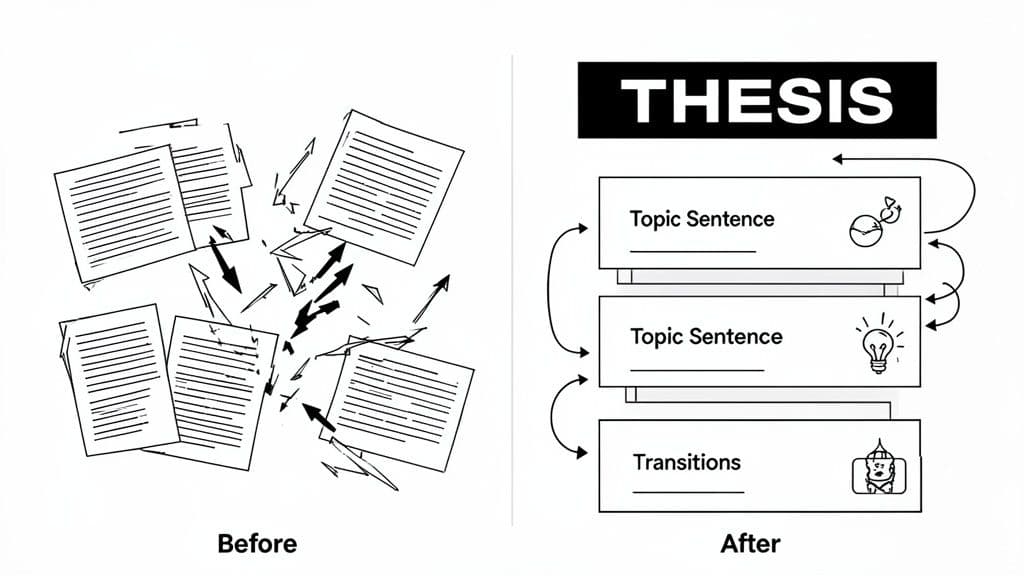
4. Coherence and Organization Failures: Structuring Essays with Clear Logic Flow
A common roadblock for TOEFL test-takers is a disorganized essay. Even with good grammar, a response can earn a low score if it lacks a clear thesis, logical topic sentences, and smooth transitions. The problem is a failure to build a coherent argument that an evaluator can follow. This problem-solving approach offers a direct solution: using essay templates and outline feedback to build a strong, predictable structure.

This method moves you from guesswork to guided construction. Instead of hoping your ideas connect, you follow a proven framework. This is one of the most practical problem solving essay examples because it provides a scaffold to organize your thoughts logically, a skill essential for both the Academic Discussion and the Write an Email tasks. Tools like the Writing30 AI template library offer the exact structures needed for the 2026 TOEFL format.
How It Works: A Step-by-Step Solution
The solution focuses on making your essay’s logic visible and easy to grade. By using a template, you give your argument a skeleton, ensuring every part serves a purpose. This is especially helpful for the Academic Discussion task.
Problem: Ideas are present but disconnected and hard to follow.
Solution: Use an Academic Discussion template to structure your post. The template guides you on where to state your main point, where to add supporting evidence, and how to conclude, ensuring your argument is clear from the first sentence to the last.
Problem: Emails feel rambling and unprofessional.
Solution: Apply a Write an Email template. This helps you quickly establish the purpose of your message, present your query or information clearly, and end with a professional closing, respecting the reader's time.
Strategic Insight: A good template doesn’t restrict you; it frees you. By handling the structure, it allows you to focus your mental energy on developing strong ideas and choosing precise vocabulary. One student saw their coherence score jump from 2/5 to 4/5 after just a few practice sessions using a template, as it taught them to place topic sentences correctly.
Actionable Tips for Implementation
To make templates and outlines work for you, integrate them into your practice routine.
- Outline First: Spend 2-3 minutes creating a brief outline using the template's framework before you start writing. This small investment pays huge dividends in clarity.
- Study the Structure: Before writing, analyze the template. Understand why it suggests placing your strongest argument in a specific position or using a transition word in a certain spot.
- Compare and Revise: After writing, compare your essay's structure to the template and the AI feedback from writing30.com. Identify where your logic broke down. A user who struggled with rambling emails completed five practice tasks, focusing only on adhering to the template’s format, and dramatically improved their organization.
5. Grammar and Sentence Construction Errors: Mastering the New Build a Sentence Task
Persistent grammatical mistakes, such as subject-verb agreement errors, tense inconsistency, and awkward complex sentence structures, often act as a direct barrier to higher TOEFL writing scores. Many students struggle because they don't know how to fix these fossilized errors effectively. This approach presents a clear problem-solution framework: isolate the problem of weak grammar and solve it through targeted, repetitive practice on the new Build a Sentence task format.
This method moves beyond just identifying mistakes; it actively rebuilds your grammatical foundation. Instead of receiving feedback on a full essay and trying to untangle multiple issues at once, you focus exclusively on sentence mechanics. This is one of the most direct problem solving essay examples for TOEFL prep, as it diagnoses a core weakness and applies a precise, high-volume drill to correct it, which is essential for the 2026 TOEFL format.
How It Works: A Step-by-Step Solution
The strategy centers on using instant feedback to develop automatic grammatical accuracy. Tools designed for the 2026 exam, like the Build a Sentence module on writing30.com, are specifically created for this kind of focused training.
Problem: Chronic grammatical errors that lower your score by several points.
Solution: Complete 10-15 Build a Sentence tasks daily. Each task provides a set of words and requires you to form a grammatically correct sentence, giving you immediate feedback on correctness and structure.
Problem: Difficulty applying grammatical rules correctly in your own writing.
Solution: After each task, review the explanation for every correction. Understanding why a structure is correct (or incorrect) is more important than just seeing the right answer.
- Sample Response:
- Words Given:
The university / offers / many resources / for international students / such as / tutoring services - Correct Sentence:
The university offers many resources for international students, such as tutoring services. - The feedback would confirm the correct use of the comma before "such as" when introducing examples.
- Words Given:
- Sample Response:
Strategic Insight: This high-repetition drilling builds "muscle memory" for correct grammar. One learner who completed over 50 Build a Sentence tasks reduced their in-essay grammar errors by 60%, while another who consistently lost points for grammar improved to a score of 28/30 after two weeks of this focused practice.
Actionable Tips for Implementation
To get the most out of this focused practice, integrate it systematically into your study plan.
- Track Your Errors: Pay close attention to the feedback. Notice if you are repeatedly making mistakes with articles, prepositions, or verb tenses. This data tells you exactly where to focus your learning.
- Apply Immediately: After a session of Build a Sentence drills, immediately write an Email or Academic Discussion response. Try to consciously apply the sentence patterns you just practiced.
- Use It as a Warm-Up: Many ESL classes now use the Build a Sentence module as a daily warm-up to improve the entire class's grammar baseline. You can adopt this yourself by starting every study session with 15 minutes of sentence drills.
6. Insufficient Preparation and Practice Volume: Scaling from Zero to Test-Ready
A major problem for many TOEFL candidates is a simple lack of practice volume. They may review concepts and write a handful of essays, but they fail to build the "muscle memory" needed for high performance under time constraints. This inadequate preparation leads to predictable errors in grammar, structure, and timing. The solution is to enable high-volume, low-cost practice using AI platforms, allowing for dozens or even hundreds of submissions.
This approach directly attacks the problem of insufficient repetition by making extensive practice affordable and accessible. Instead of rationing practice attempts due to cost or the limited availability of human graders, you can immerse yourself in the test format. This stands out as one of the most practical problem solving essay examples because it offers a direct, scalable fix to one of the most common reasons for low scores: not doing enough work.
How It Works: A Step-by-Step Solution
The core of this solution is to commit to a high-volume practice schedule using a tool that provides unlimited submissions and instant feedback. A platform like writing30.com is designed for this exact purpose, removing barriers to consistent training for the 2026 TOEFL.
Problem: Not enough exposure to all three TOEFL writing tasks.
Solution: Set a weekly submission goal (e.g., 15 tasks) and distribute it across Build a Sentence, Write an Email, and Academic Discussion prompts. This ensures you are not just strong in one area but prepared for the entire section.
Problem: Unsure if practice is actually leading to improvement.
Solution: Use the platform's feedback cards and score history to track progress. Every 2-3 weeks, take a full mock test to measure how your targeted practice translates to an overall score increase.
Strategic Insight: High-volume practice is about building reflexes. A student who started 8 weeks before their exam used a plan on Writing30 to complete over 120 submissions. This relentless practice helped them identify and fix fossilized errors, raising their score by 8 points.
Actionable Tips for Implementation
To make this solution effective, you must be systematic. Random practice is not enough.
- Choose the Right Plan: If your exam is a few months away, consistent practice is key. For focused, short-term prep, dedicating specific time slots allows for intense bursts of practice.
- Review Feedback in Batches: Don't just submit and forget. Dedicate a session each week to review all your feedback cards. Look for recurring error patterns and make them your top priority for the following week.
- Prioritize Based on Diagnostics: After your first few practice tasks, identify your weakest area. If your emails lack a clear purpose, spend 60% of your next week's practice on that specific task type until your scores improve. A working professional used a weekly plan for 30-minute daily sessions, mastering the email format in just two weeks.
7. Professional and Academic Email Writing Gaps: Mastering the New Email Task
Many non-native English speakers, both students and professionals, struggle with the specific conventions of formal email writing. The problem is a lack of confidence and practice in a skill that is essential for success in universities and workplaces. This problem-solving approach targets this gap directly by using the new TOEFL 2026 "Write an Email" task as a framework for structured practice and feedback on professional tone.
This method turns a common point of anxiety into a focused area for improvement. Instead of guessing at appropriate phrasing, you receive clear guidance on tone, clarity, and conciseness. This is one of the most practical problem solving essay examples for real-world application, as the solution develops a skill required daily in academic and professional life, directly addressing the gap identified by the TOEFL exam's redesign.
How It Works: A Step-by-Step Solution
The solution centers on using targeted practice to build confidence and competence in email communication. By isolating this specific writing format, you can quickly master the nuances of tone and structure without the pressure of a longer academic essay. Platforms designed for the 2026 TOEFL format provide the ideal training ground.
Problem: Uncertainty about formal tone and professional phrasing.
Solution: Focus exclusively on Write an Email tasks. These exercises simulate real-world scenarios, like writing to a professor or a university office.
- Sample Response:
- Scenario: You missed a class and need to ask your professor for the lecture notes.
- Strong Response:
Dear Professor Smith, I hope this email finds you well. I am writing to respectfully request the lecture notes for the PSY 101 class I missed on October 26th due to a medical appointment. I would be very grateful if you could share them or let me know if they are available on the student portal. Thank you for your understanding. Sincerely, [Your Name] - This response is polite, direct, and provides all necessary information.
- Sample Response:
Problem: Poorly structured emails that are hard to read.
Solution: Use provided templates from writing30.com to understand the conventional structure of a professional email, including subject lines, greetings, body paragraphs, and closings.
Strategic Insight: Mastering email writing is not just about grammar; it's about understanding cultural and professional norms. A business professional who practiced with these tasks stopped needing assistance to write client emails in English, reporting a major boost in confidence and efficiency at work.
Actionable Tips for Implementation
To make this solution effective, integrate practice with real-world application.
- Study Contextual Templates: Don’t just use one generic template. Find examples that match your specific needs, whether for academic inquiries or administrative requests. For a deeper look, this email writing guide offers detailed examples.
- Focus on Tone Feedback: Pay close attention to feedback on your tone. An international student improved their communication grade from a B to an A by adjusting their emails to professors based on feedback that their initial drafts were too informal.
- Practice Conventions: Drill subject lines, openings, and closings. These small details signal professionalism and are easy to master with consistent practice, building a strong foundation for your overall communication skills.
8. Test Anxiety and Confidence Deficit: Building Fluency Through Controlled Mock Testing
Test anxiety often creates a vicious cycle where fear of failure undermines actual performance, leading to the very outcome the test-taker dreads. The problem is not a lack of knowledge but an inability to access and apply it under pressure. This problem-solving approach targets performance anxiety directly by proposing a solution of regular, low-stakes mock testing to build resilience and confidence. You can do this!
By repeatedly simulating the exam environment, you desensitize yourself to the pressure, making the actual test feel like just another practice session. This is one of the most powerful problem solving essay examples because it addresses the psychological barrier to success. The solution is not just about practicing content; it's about practicing the experience of the test itself to build mental fortitude.
How It Works: A Step-by-Step Solution
The core of this solution is using controlled exposure to reduce the stress response associated with high-stakes testing. Integrated practice platforms like writing30.com offer AI-powered mock tests that replicate the timing, format, and pressure of the actual TOEFL exam, providing a safe space to build endurance.
Problem: Freezing or making simple mistakes under time pressure.
Solution: Take a full mock test at least every two weeks. This helps you internalize the pacing required for each task, from the quick Build a Sentence drills to the more involved Academic Discussion, turning time from an enemy into a familiar constraint.
Problem: A confidence deficit caused by not knowing what to expect or where you stand.
Solution: Use the estimated scores from mock tests to set realistic goals. Seeing your progress over time provides tangible proof of improvement, which is a direct antidote to anxiety.
Strategic Insight: One student who took 12 mock tests over 12 weeks not only reduced their anxiety but also identified that their scores consistently dropped on the Academic Discussion task when they had less than 10 minutes left. This allowed them to reallocate their time, leading to a 6-point increase on the real exam.
Actionable Tips for Implementation
To make this solution effective, integrate mock tests into your study plan with clear intention.
- Establish a Baseline: Take your first mock test without any special preparation. This initial score provides an honest starting point and highlights your immediate areas of weakness, guiding your focused practice.
- Simulate Real Conditions: Take your mock tests at the same time of day as your scheduled official exam. This helps regulate your body clock and mental energy to peak performance levels.
- Analyze Your Anxiety Triggers: After each mock test, review your performance and feedback. Compare scores across tasks to identify which ones cause the most anxiety-driven errors and dedicate more practice time to them. Anxious test-takers often find that consistent practice with the Write an Email task builds the confidence needed to tackle the more open-ended final task.
Final Thoughts
Our journey through these detailed problem solving essay examples has demonstrated a clear, repeatable path to mastering the TOEFL writing section. We've moved far beyond simply reading sample texts. Instead, we have dissected the anatomy of high-scoring responses for the 2026 format, revealing the underlying strategies that turn a decent response into an exceptional one. You've seen how to identify a problem's core components, structure a logical and persuasive solution, and support your claims with specific, convincing evidence.
The examples we analyzed, from addressing low TOEFL scores to managing test anxiety, were not just showcases of good writing. They served as practical blueprints. Each breakdown highlighted the crucial connection between a clearly defined problem and a well-argued solution—a principle that is the heart of effective academic and professional communication.
Your Strategic Takeaways
The most powerful lesson from these examples is that strong problem-solution writing isn't about magic; it's about method. It’s about applying a consistent framework to any given prompt. Let’s distill the most important strategies you should carry forward:
- Deconstruct the Prompt: Before writing a single word, isolate the precise problem in the Academic Discussion post or the Email scenario. What is its scope? Who is affected? What are the root causes? A precise problem definition leads to a focused and effective solution.
- Structure is Your Skeleton: The classic structure (Introduction with problem/thesis, Body Paragraphs with solutions and support, Conclusion with a summary and final thought) is your greatest asset. As seen in our analyses, this format provides clarity and guides your reader logically from issue to resolution.
- Evidence is Everything: A proposed solution without evidence is just an opinion. Use specific details, logical reasoning, and, where appropriate, personal-yet-relevant examples to make your solution believable and compelling. This is a non-negotiable for achieving a high score (25-30).
- Master the Language of Solutions: Incorporate transition words and phrases that signal problem-solution logic. Terms like "A primary cause is," "One effective solution would be," "As a result," and "Therefore" are the signposts that create a coherent argument.
From Analysis to Action: Your Next Steps
Viewing these problem solving essay examples is just the beginning. True improvement comes from deliberate practice. Your immediate goal should be to internalize the methods we've discussed and apply them to your own writing. Start by focusing on the 2026 TOEFL writing tasks: Build a Sentence, Write an Email, and Academic Discussion.
For the Academic Discussion, practice identifying the problem presented in the professor's post and crafting a contribution that not only states your idea but also implicitly solves a piece of the puzzle. For the Email task, focus on recognizing the problem in the scenario and writing a clear, polite, and effective message that proposes a direct solution or requests action.
Remember the common errors we highlighted, such as vague solutions or a lack of organizational flow. Actively look for these weaknesses in your own practice essays. Are your solutions specific and actionable? Is your essay easy to follow? This self-correction loop, informed by the high-scoring examples, will accelerate your progress significantly. By moving from passive reading to active application, you transform these insights into test-day habits, building the confidence and skill needed to earn the score you deserve.
Ready to stop just reading and start practicing? Get instant, AI-powered feedback on your problem-solution writing for every TOEFL task type with Writing30 AI. Our tool analyzes your responses using the official ETS rubric, providing specific suggestions to improve structure, vocabulary, and grammar, helping you turn theory into a top score. Try our free practice questions now and see how your writing improves at Writing30 AI.
Ready to Practice?
Try all 3 TOEFL 2026 writing tasks with instant AI feedback.
Tags
Ready to Improve Your TOEFL Writing?
Get instant AI-powered feedback on your TOEFL writing. Practice with real prompts and see your score improve.
Try Writing30 AI