
Mastering the 2026 ETS TOEFL Official Guide
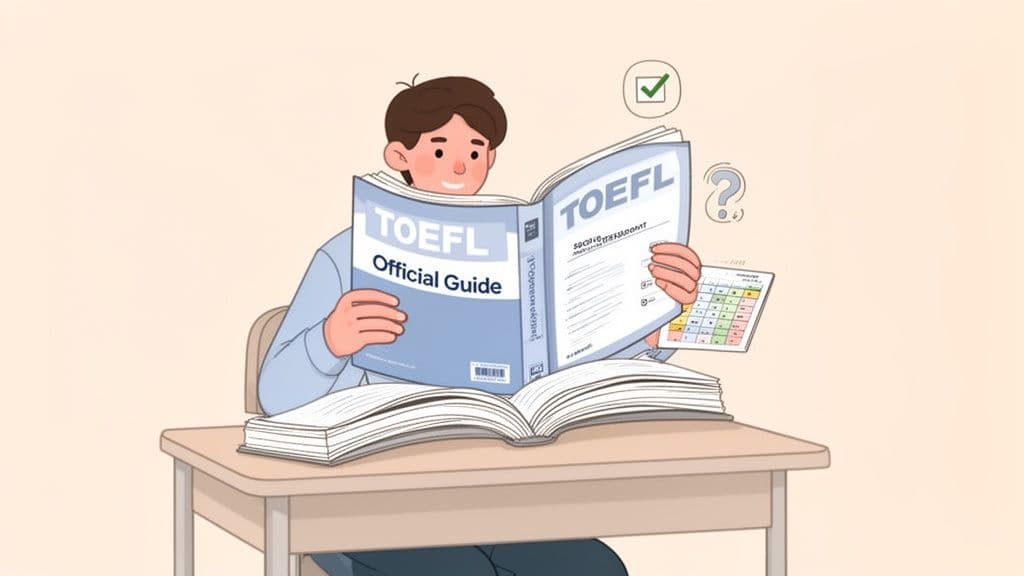
Feeling overwhelmed by the sheer volume of TOEFL prep material out there? You're not alone, and it's completely normal to feel anxious. Let's cut through the noise together. The ETS TOEFL Official Guide is your direct line to the test creators, making it the single most important book you can buy for your 2026 prep.
Think of it as the official rulebook for the exam. Everything else is just someone's best guess. We'll guide you through how to use it effectively so you can walk into your test feeling confident and prepared.
Your First Look Inside the TOEFL Official Guide

Preparing for the TOEFL can feel like trying to hit a moving target, especially with the new 2026 format changes. This is where the ETS TOEFL Official Guide becomes your anchor. It isn’t just another prep book; it’s the blueprint designed by the very people who write and score the test you'll be taking.
The guide pulls back the curtain on the entire exam, giving you authentic, retired questions so you know exactly what to expect. For most students, anxiety comes from the unknown. Working through this book eliminates surprises, building your confidence by getting you used to the test's specific logic and question style.
Why This Guide Is Your Starting Point
The real power of the official guide is its authenticity. Unofficial books and websites can be great for extra practice, but they are only imitating what the real TOEFL is like. This guide gives you the facts.
- Authentic Questions: You get to practice with real questions that have appeared on past TOEFL tests. No guesswork.
- Official Scoring Rubrics: It shows you the exact criteria that both human and AI raters will use to grade your Writing and Speaking responses.
- Detailed Explanations: Every single answer is explained, so you can learn the reasoning behind the correct—and incorrect—choices.
Understanding these rubrics is absolutely critical for a high score, especially for the challenging 2026 Writing section. The guide walks you through the three writing task types: Build a Sentence, Write an Email, and Academic Discussion. It gives you the prompts and, more importantly, shows you what a high-scoring response actually looks like.
The goal isn't just to see the right answers. It's to understand why they are right according to ETS standards. This insight is what lets you build a real strategy for hitting your target score.
But here's the catch: the guide shows you what a good response is, but it can’t give you personal feedback on your practice attempts. This is where a smart study plan comes in.
For example, a great actionable tip is to take a writing prompt from the book and practice your response on a platform like Writing30. It gives you instant, rubric-based feedback, turning passive reading into active, targeted practice. This combination will put you on a clear path to success.
A Guided Tour of the 2026 Edition

When you crack open the latest ETS TOEFL Official Guide for the 2026 format, you’re not just holding a textbook. You’re getting a behind-the-scenes look at the exact test you'll face, straight from the people who create it. It’s a powerful tool, and we’re here to help you use it.
Let's walk through what’s inside the 2026 edition and, more importantly, how each piece fits into a supportive and effective study plan.
What's Inside the Guide
At its heart, the guide is a collection of full-length practice tests. These aren't just similar—they are actual retired exams, which is the closest you can get to the real thing without being in the test center. The 2026 edition is specifically updated to reflect the newest question formats, making every minute you spend with it highly relevant.
The book breaks down each TOEFL iBT section: Reading, Listening, Speaking, and Writing. For every question type, you'll find detailed explanations and test-taking strategies directly from ETS.
Here’s a breakdown of what the 2026 guide offers and why it matters for your prep.
ETS Official Guide 2026 Edition At a Glance
| Component | Description | Why It's Important for 2026 |
|---|---|---|
| Full-Length Practice Tests | Complete, retired TOEFL iBT exams updated for the 2026 format, including all new writing tasks. | Simulating test day conditions is the best way to build stamina and master time management for the focused sections. |
| Official Scoring Rubrics | The exact scoring criteria used by both human raters and the e-rater® AI system to evaluate your responses. | This is your cheat sheet. It tells you exactly what graders are looking for so you can tailor your answers to meet their expectations. |
| Detailed Answer Explanations | In-depth explanations for every question, showing the logic behind correct—and incorrect—answers. | It's not enough to know the right answer; you need to understand why it's right. This helps you spot patterns and avoid common traps. |
This table shows why the guide’s authenticity is its biggest strength. You're not just guessing; you're learning how the test makers think, which can be a huge confidence booster.
A Closer Look at the 2026 Writing Section
For most test-takers, the Writing section is the most daunting part of the TOEFL. The 2026 updates introduced a whole new set of challenges, but you can absolutely master them with the right approach. The guide dedicates a solid chunk of its pages to the three new task types:
- Build a Sentence: This tests your grammar and ability to form a logical English sentence quickly.
- Write an Email: This measures practical writing skills by asking you to compose a clear and appropriate email.
- Academic Discussion: This requires you to contribute to an online class discussion, analyze what others have said, and add your own well-supported opinion.
The ETS TOEFL Official Guide provides sample prompts and high-scoring examples for each new task. These are fantastic for understanding what a top-scoring response looks like.
Here’s an actionable tip: After reviewing an official sample for the "Write an Email" task, immediately try to write your own version of that email without looking at the book. Then, compare your version to the official example. What phrases did they use that you didn't? How was their tone different? This simple exercise builds active learning.
The guide’s main drawback is the limited number of practice questions. The examples are great, but you'll almost certainly need more repetitions to feel truly ready. You can dive deeper into the specifics by reviewing a full breakdown of the TOEFL 2026 changes.
Think of the guide as your foundation. Use it to learn the rules of the game—the question types, the rubrics, and the strategies. Then, turn to a tool like Writing30.com for the unlimited practice and instant, AI-powered feedback you need to master the skills and hit your target score.
Is the Official Guide Enough for a High Score?
This is the big question every student asks. You’ve got the ETS TOEFL Official Guide, the most authentic book for this test. So, is that all you need to achieve your dream score?
The honest answer is no. It's absolutely essential, but it's not enough by itself. And that’s okay! Recognizing this is the first step to building a truly effective study plan.
Think of the official guide as your map and compass. It shows you the terrain—all the question types, the rules, and exactly what the graders are looking for. You simply can't prepare without it. Trying to study for the TOEFL without the official guide is like trying to navigate a new city blindfolded.
The guide's real power comes from its source. Every question is made by ETS, the same people who make the real exam. When you practice with their material, you get a perfect feel for the test's difficulty, tone, and logic.
The Problem with Practice Volume
The biggest issue with only using the ETS TOEFL Official Guide is that you’ll run out of material—fast. The book only has a few full-length practice tests. These are gold for simulating real exam conditions, but you'll burn through them quickly.
The TOEFL is a skills test. To get good, you need repetition. You have to build muscle memory for every task, especially in the fast-paced 2026 Writing section. A few sample prompts for "Build a Sentence" or "Write an Email" just isn't enough practice to master them under pressure.
The Critical Feedback Gap
But there’s a much bigger problem: it’s a one-way street. The guide can show you what a perfect score looks like, but it can’t tell you a single thing about your own writing.
This is the most common trap in any self-study plan. You can write dozens of practice essays, but without feedback, you have no idea if you're actually improving or just reinforcing bad habits. Are your transitions clunky? Is your vocabulary too simple? Do you keep making the same grammar mistakes?
A book can’t answer those questions.
You can’t grade your own homework. Without objective, rubric-based feedback, you are essentially practicing blind. This is why so many students get stuck at the same score, making the same mistakes without even realizing it. It's a frustrating feeling, but one you can avoid.
Let's look at the "Academic Discussion" task. A response that earns a high score (4-5) needs to be well-developed and show strong language use.
Sample Student Response (Mid-Range): "I think Maria is right that solar power is good. It is a clean energy. But it is expensive. Also, it doesn't work at night. So, it is not a perfect solution. We need other things too."
A student might think this is a good answer—it addresses the prompt. But this response would likely score in the low-to-mid range (2-3). It uses simple sentences, basic vocabulary ("good," "things"), and doesn't develop its points with any depth.
Without feedback, that student would just keep writing responses like this. An AI tool like Writing30 would immediately flag the choppy sentences and suggest using transition words like "However" or "Furthermore." It would also prompt the student to explain why solar power isn't a perfect solution with specific examples. That is the targeted feedback that leads to real score increases.
If you're trying to decide how to build your study plan, you might find our breakdown of the TOEFL Official Guide vs. free resources helpful.
The official guide is the perfect tool for learning the rules of the game. But to win, you need a coach to watch you play and show you exactly how to get better.
Combine the Guide with AI for Writing Success
The ETS TOEFL Official Guide is an essential starting point, but to really crush the Writing section, you need to practice in a way that gives you feedback. We know this part can be tricky, but there’s a clear path forward.
Think of the guide as the textbook that explains the rules. An AI tool like Writing30 is the simulator where you play the game over and over, seeing your score and mistakes in real time. Combining them is how you build a winning strategy.
The guide gives you the "what"—official prompts, the scoring rubrics, and examples of high-scoring answers. The AI gives you the "how"—the endless practice and instant, personalized feedback you need to fix your specific weaknesses.
Create a Powerful Study Loop
The most effective study method is a feedback loop connecting the book to an AI platform. This turns passive reading into active, targeted practice. You can do this!
- Learn from the Guide: Start in the Writing section of the official guide. Really dig into the scoring rubrics for the 2026 tasks like ‘Write an Email’ and ‘Academic Discussion.’ Understand what a score in the 4.0-5.0 range actually requires.
- Practice with AI: Grab a prompt straight from the book and write your response on an AI platform. Try writing an ‘Academic Discussion’ post and submit it to the Writing30 AI.
- Get Instant Feedback: In seconds, you get an estimated score and a detailed breakdown based on the official ETS criteria. The AI will flag specific problems with grammar, coherence, vocabulary, and sentence variety.
- Revise and Resubmit: This is the most important step. Use the AI’s suggestions to fix your response. Then, submit it again. Did your score go up? This cycle of practice, feedback, and revision is how you break through scoring plateaus.
This synergy turns the theory from the book into real skill, building the muscle memory you need to feel confident on test day.
The official guide by itself is a one-way street: you read the book, maybe try a practice test, and then... you're done. You're left guessing if you actually improved. This diagram shows exactly where that process breaks down.

The key takeaway is that dead end. Without feedback, you’re just practicing in the dark, hoping you’re getting better but with no way to be sure.
Target Your Weaknesses with Precision
One of the biggest frustrations for TOEFL students is not knowing what to fix. You might just feel your writing is "bad" without being able to pinpoint why. Pairing the ETS TOEFL Official Guide with AI is a total game-changer.
Let's say you're practicing the 'Write an Email' task. Your first draft might look like this:
Sample 'Write an Email' Draft: Subject: Question about project
Dear Professor Smith, I have a question. My group is having a problem with our project. We cannot find good sources. Can you help us? Maybe give us some ideas. Thanks.
This gets the point across, but it lacks the professional tone and specific detail needed for the high-score (4.0-5.0) range. After putting that draft into Writing30, you'd get specific, actionable feedback like this:
- Tone: "Your tone is too informal. Try more polite phrasing like 'I am writing to respectfully ask for guidance' instead of 'I have a question.'"
- Vocabulary: "Upgrade 'good sources' to more academic alternatives like 'scholarly articles' or 'peer-reviewed journals.'"
- Coherence: "Your request is vague. Specify what you've already tried. For example: 'We have already searched the university library database but are struggling to find relevant materials.'"
You simply can’t get this level of targeted advice from a book. It lets you make specific changes, practice them, and build the writing habits that match the official scoring rubrics. If you're wondering how AI scores stack up against the real deal, it's worth understanding the relationship between mock scores and real test results.
The Power of Synergy: The official guide gives you the destination (a high-scoring response). An AI tool gives you the turn-by-turn directions to get there from where you are right now.
Looking at official score data shows why this is so critical. The mean Writing score for test-takers is consistently lower than other sections, often around 21 out of 30. This highlights just how tough these tasks are, especially the new 2026 formats. Getting unlimited practice with instant score estimates from Writing30 gives you a massive leg up. You can see a full breakdown in the complete TOEFL score data summary from ETS.
Your Weekly TOEFL Study Plan Using the Guide

Having the ETS TOEFL Official Guide is a great first step. But the book itself won't raise your score—a smart, consistent plan will. This schedule is designed to be effective without burning you out. It shows you exactly how to pair the official guide with a powerful AI tool like Writing30.
Consistency beats cramming every time. You've got this!
The Weekly Rhythm: Monday to Thursday
Your weekdays are for building specific skills. Instead of bouncing between sections, dedicate each day to one area. This builds deep mastery and makes your study time count.
Monday: Reading Focus Start your week by doing a full Reading section from a practice test in the guide. Set a timer! Afterwards, review every question—especially the ones you missed—using the guide’s answer key to get inside the test-maker's head.
Tuesday: Writing Deep Dive (Academic Discussion) Time for writing. Pick an ‘Academic Discussion’ prompt from the guide. Write your response, then paste it into the Writing30 AI for immediate feedback.
Actionable Tip: After seeing your score, revise your response at least twice. Zero in on the AI’s suggestions. Are you improving coherence, adding stronger transition words, or backing up your arguments? This revision cycle is where the real learning happens.
Wednesday: Listening Practice Use the guide’s digital access to complete a full Listening section. Time yourself strictly. When you’re done, review your answers and read the transcripts for any questions that tripped you up.
Thursday: Writing Deep Dive (Email and Sentence Building) This day is for the other new 2026 writing tasks. Knock out several ‘Build a Sentence’ questions to improve your grammar and speed. Then, write a response to a ‘Write an Email’ prompt from the guide.
Friday: Practice and Review
Friday is for putting it all together. This is your chance to simulate test-day pressure and pinpoint weaknesses before the weekend.
- Timed Mini-Test: Create a short, timed practice session. Do one Reading passage, one Listening lecture, and one ‘Academic Discussion’ prompt. This forces you to practice switching between task types.
- Writing Revision: Take the email you drafted on Thursday and run it through the Writing30 feedback engine. Analyze the AI's notes on your tone and clarity. Revise it until you push your score into the high (4.0-5.0) range.
- Mistake Log: Spend 20 minutes reviewing the errors you made all week. Finding patterns is the first step to fixing them for good.
Your Weekend Strategy
Weekends are for comprehensive review and endurance training.
Saturday: Full Test Simulation (Every Other Week) Once every two weeks, it's time for a full-length practice test from the ETS TOEFL Official Guide. Find a quiet space, turn off your phone, and do the entire exam in one sitting. This is critical for building mental endurance.
Sunday: Active Review and Planning Use Sunday to analyze your practice test. Don't just check your answers—figure out why you made each mistake. If you're hungry for more material, check our guide on finding a quality TOEFL practice test in PDF format. Finally, map out your plan for the week ahead.
This balanced approach prevents burnout while ensuring you make consistent, measurable progress. By combining the authentic material in the official guide with targeted AI feedback from Writing30, you're building a powerful system for success.
Choosing the Right Guide and Avoiding Pitfalls
Grabbing the ETS TOEFL Official Guide is a great first step. But be careful—it’s surprisingly easy to buy an old version online and waste weeks studying for the wrong test.
Your top priority is making sure you have the guide for the 2026 TOEFL format. Check the cover and description for the new writing tasks: Build a Sentence, Write an Email, and Academic Discussion. If a guide doesn't mention these, it's obsolete. Don't buy it.
Make Sure You Buy the Right Edition
Having the right book is one thing, but how you use it is what really matters. Students often make the same mistakes, which can hinder their progress.
Here are the biggest traps to avoid:
- Passive Reading: Just reading answer explanations won't get you a high score. You have to take the practice tests under timed conditions and really dig into why you made mistakes.
- Memorizing Sample Essays: The sample answers are for learning the style and structure of a good response, not for memorization. ETS graders can spot memorized text, and it will hurt your score.
- Ignoring the Clock: The TOEFL is as much about speed as it is about English. If you don't practice with a timer, you won't build the pace you need on test day.
The data backs this up. With a global pool of over a million test takers annually, the average score hovers around 88. Official ETS data shows that high scorers consistently use official guides. You can see the full breakdown in the ETS score summary report.
This is more important than ever. Regional writing scores have been slipping, so targeted practice on the new 2026 tasks is non-negotiable. For tasks like "Write an Email," where achieving the right tone and coherence is a huge challenge, a book alone isn't enough. Tools like Writing30 are essential for getting the rubric-based feedback you need to improve.
A Checklist for Effective Study
Follow this checklist from day one. It's the difference between just reading a book and actively preparing to hit your target score.
Your Study Checklist:
- Confirm the 2026 Edition: Double-check the cover for the new writing tasks before you buy.
- Simulate Real Test Conditions: Every single practice test needs a timer. No exceptions.
- Analyze Every Mistake: Don't just see what the right answer is. Figure out why your answer was wrong and the correct one is right.
- Practice Actively, Not Passively: Use the book’s prompts to write your own full responses.
- Get External Feedback: The book can't score your essays. Use an AI tool like Writing30 to get scores and specific feedback on your writing.
Don't let a fantastic resource like the official guide go to waste. Use it the right way, and you'll be building the skills you actually need for test day.
Your Questions About the Official Guide Answered
As you dive into your TOEFL prep, you’ll probably have a few questions about the best way to use the ETS TOEFL Official Guide. It's a common experience, and we're here to provide clear, supportive answers so you can build your study plan with confidence.
Is the Official Guide Enough for a High Score?
Here’s the honest truth: The Official Guide is the absolute best source for authentic TOEFL questions. But on its own, it’s not enough for a top score, especially in the Writing section.
The guide gives you prompts, but it can't tell you how well you answered them. It's like practicing a speech without ever getting feedback. To actually get better, you have to pair the guide's prompts with a tool that gives you instant, rubric-based feedback. That's where a tool like Writing30 comes in, turning practice into real, measurable progress.
Can I Use an Older Edition for the 2026 Test?
No, and please don't make this common mistake. The TOEFL format for 2026 introduced major changes.
The test now includes three new writing tasks: Build a Sentence, Write an Email, and Academic Discussion. Any guide published before these changes became standard won't cover them. You'd be studying for a test that no longer exists. Always, always use the latest edition.
How Should I Use the Practice Tests in the Guide?
Think of the practice tests as a full dress rehearsal. Don't just do a few questions here and there. Set aside the full testing time, find a quiet spot, and take an entire test in one sitting. This is the only way to build the focus and stamina you'll need.
After you finish, the real work begins. Take your writing responses and plug them into an AI evaluator like Writing30. You’ll get an estimated score and a detailed breakdown of what you did right and what you can improve. This helps you zero in on your weak spots before you attempt the next simulation. To really get inside the grader's head, take a look at our complete breakdown of the TOEFL writing rubric.
Ready to put these strategies into action and take control of your prep? Stop practicing in the dark. At Writing30, you can get instant feedback on unlimited practice attempts for every new 2026 writing task. You can do this!
Ready to Practice?
Try all 3 TOEFL 2026 writing tasks with instant AI feedback.
Tags
Ready to Improve Your TOEFL Writing?
Get instant AI-powered feedback on your TOEFL writing. Practice with real prompts and see your score improve.
Try Writing30 AI